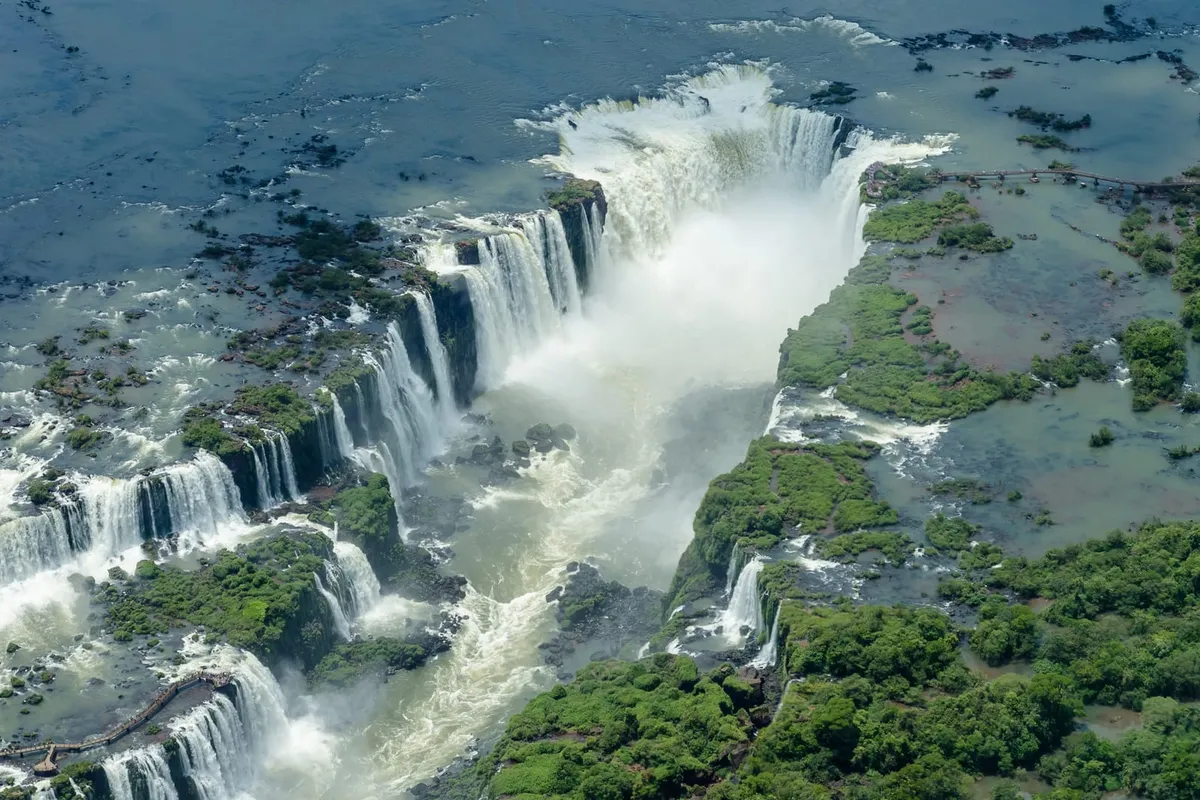
The Brazilian side of Iguazu Falls offers the panoramic postcard view of all 275 cataracts spread across 3 km of the Iguazu River — the photo you\'ve seen in every travel magazine. Located in Parque Nacional do Iguaçu in Paraná state, Brazil (UNESCO World Heritage Site #355, inscribed 1986, two years after the Argentine side at #303), the park sits across the river from the Argentine side and offers a complementary experience: where the Argentine side gives you full immersion (walking over, beside and beneath the falls), the Brazilian side gives you distance and perspective — a 1.2 km panoramic walkway along the cliff edge with progressively closer views of the entire falls system, ending at a metal platform that extends out into the spray of the Devil\'s Throat (Garganta do Diabo). The closest town is Foz do Iguaçu, 17 km from the park entrance and just 25 km from Puerto Iguazú (Argentina) across the Tancredo Neves Bridge. Most travellers visit both sides, dedicating 3–4 hours to Brazil and a full day to Argentina; the classic itinerary is one day Brazilian side + one or two days Argentine side. The Macuco Safari boat ride and the adjacent Parque das Aves bird park are the most popular add-ons.


Getting there — distances & times
| From | Distance | Flight | Bus | Drive |
|---|---|---|---|---|
| New York (JFK) | 8700 km | 10 h + 2 h layover | — | — |
| Madrid (MAD) | 10300 km | 13 h + 2 h layover | — | — |
| Buenos Aires (EZE) | 1300 km | 1 h 45 | 18 h | 15 h |
| São Paulo (GRU) | 950 km | 1 h 40 | 16 h | 14 h |
| Córdoba | 1100 km | 1 h 30 | 16 h | 14 h |
Month-by-month climate
| Month | Temp. | Rain | Crowds | Note |
|---|---|---|---|---|
| Jan | 22° / 33°C | 170 mm | Humid summer | |
| Feb | 22° / 32°C | 160 mm | ||
| Mar | 21° / 31°C | 155 mm | ||
| Apr | 18° / 28°C | 160 mm | Mild, ideal | |
| May | 14° / 25°C | 125 mm | ||
| Jun | 12° / 22°C | 110 mm | ||
| Jul | 11° / 23°C | 85 mm | Winter break | |
| Aug | 13° / 25°C | 90 mm | ||
| Sep | 14° / 26°C | 130 mm | Clear skies | |
| Oct | 17° / 28°C | 160 mm | ||
| Nov | 19° / 30°C | 155 mm | ||
| Dec | 21° / 32°C | 170 mm |
Getting to the Brazilian side
| From | Distance | Flight | Bus | Drive |
|---|---|---|---|---|
| Foz do Iguaçu town | 17 km | — | 30 min (line 120) | 20 min |
| Foz do Iguaçu Airport (IGU) | 10 km | — | 15 min | 10 min |
| Puerto Iguazú (Argentina) | 25 km | — | 40 min + border | 30 min + border |
| Cataratas del Iguazú (IGR) | 15 km | — | shuttle | 15 min |
| São Paulo (GRU) | 950 km | 1 h 40 to IGU | — | — |
| Buenos Aires (EZE) | 1300 km | 1 h 45 to IGR + cross border | — | — |
Typical prices by category
| Category | Budget | Mid-range | Luxury |
|---|---|---|---|
| Park entry (foreigner) | USD 22 | USD 22 | USD 22 |
| Park entry (Brazilian) | USD 15 | USD 15 | USD 15 |
| Macuco Safari boat | USD 60 | USD 60 | USD 60 |
| Helicopter ride (10 min) | USD 160 | USD 160 | USD 160 |
| Parque das Aves (next door) | USD 15 | USD 15 | USD 15 |
| Tour from Foz | USD 40–60 | USD 70–110 | USD 150–250 |
Park entry fluctuates with the Brazilian real. Macuco Safari and helicopter are operated by separate concessionaires inside the park.
The Visit — Step by Step
The Brazilian park is much smaller and more linear than the Argentine side, which makes it faster to visit but less immersive. The flow:
- Visitor Centre: arrive at the park gate, buy tickets (or scan your pre-purchased ticket), pass through the turnstiles. There\'s a small museum, restrooms, gift shop and food court.
- Park bus: the official double-decker bus (included with entry) takes you on a 12 km road through the rainforest to the start of the panoramic walkway. The bus is the only way to access the walkway — no private vehicles allowed past the visitor centre.
- Panoramic walkway: the 1.2 km trail follows the cliff edge along the south side of the river, opposite the Argentine side. As you walk, the falls progressively reveal themselves at different angles. There are multiple railed lookouts.
- Garganta do Diabo platform: at the end of the trail, a metal walkway extends 100 metres out into the spray of the Devil\'s Throat — you stand directly in front of the largest waterfall complex while it thunders past you. You will get soaked.
- Elevator + upper level: after the platform, take the elevator (or stairs) up to a final viewpoint with the wide overview shot. This is where the iconic National Geographic photo is taken.
- Return: walk back to the bus stop and take the bus to the visitor centre.
Total time: 3–4 hours from gate to gate. Add the Macuco Safari boat (2 hours) or Parque das Aves (1.5 hours) to make it a full day.
Macuco Safari — The Boat Ride
The Brazilian equivalent of the Argentine Gran Aventura. Macuco Safari is a Zodiac speedboat ride that takes you up the river and into the spray under several smaller falls (you can\'t reach the Devil\'s Throat from the Brazilian side — that\'s only accessible from Argentina). Includes a 3 km open-truck transfer through the rainforest, a short jungle walk, and the boat ride itself. Cost: USD 60. Less dramatic than the Argentine Gran Aventura but cheaper. You will get completely soaked — bring a swimsuit and dry clothes. Operates 09:00–17:00; book in advance during high season.
Parque das Aves — The Bird Park
Right next to the park entrance, the privately-owned Parque das Aves is one of the best bird sanctuaries in South America. 1.5 km of forest trails through walk-through aviaries housing toucans, macaws, harpy eagles, owls, hummingbirds and over 150 species — most rescued from illegal trade. Entry USD 15, allow 1.5–2 hours. Open 08:30–17:30. Highly recommended if you have an extra half day in Foz, especially with kids. The harpy eagle exhibit is the only place in the world where you can see this enormous predator at eye level.
Helicopter Ride
Helisul operates 10-minute helicopter rides over both sides of the falls from a heliport just outside the park entrance. Cost: USD 160 per person (3-person minimum, but they\'ll group you with other walk-ins). The view from above is spectacular and gives you the full sense of the U-shaped Devil\'s Throat. Note: helicopter overflight is not allowed from the Argentine side due to environmental regulations — Brazil is the only place to do this.
Crossing the Border
Most travellers staying in Foz do Iguaçu visit Argentina as a day trip and vice versa. The Tancredo Neves Bridge (Friendship Bridge) is the only road crossing. Procedure:
- From Brazil to Argentina: stamp out at Brazilian immigration on the Brazilian side, drive across the bridge, stamp in at Argentine immigration on the other side.
- Total time: 30–60 minutes depending on queues.
- Most tour operators handle the paperwork and fees; doing it on your own with a rental car is also straightforward.
- Always get both stamps — you can be fined when leaving the country if your passport doesn\'t show the correct entry/exit chain.
Where to Stay
Two options for the Brazilian side:
- Inside the park — Belmond Hotel das Cataratas: the legendary pink colonial hotel inside the national park, the only accommodation with direct dawn/dusk access to the falls before public hours. USD 600–1500/night. Book months ahead.
- Foz do Iguaçu town: dozens of hotels at all budgets. Mid-range: Wish Resort Foz do Iguaçu, Bourbon Cataratas Resort. Backpackers: Hostel Bambu, Tetris Hostel. USD 30–250/night. The town centre is 17 km from the park gate.
Combining Brazil + Argentina
The classic 2-day itinerary:
- Day 1: Brazilian side (3–4 hours) + Parque das Aves (1.5 hours) + dinner in Foz
- Day 2: Argentine side full day (start at 08:00 to beat crowds at the Devil\'s Throat circuit)
3-day extended:
- Day 1: Brazilian side morning + Itaipu Dam tour afternoon + dinner in Foz
- Day 2: Argentine side full day (Devil\'s Throat + Upper + Lower circuits + Gran Aventura boat)
- Day 3: Argentine side return for Sendero Macuco jungle trail + helicopter from Brazil (afternoon)