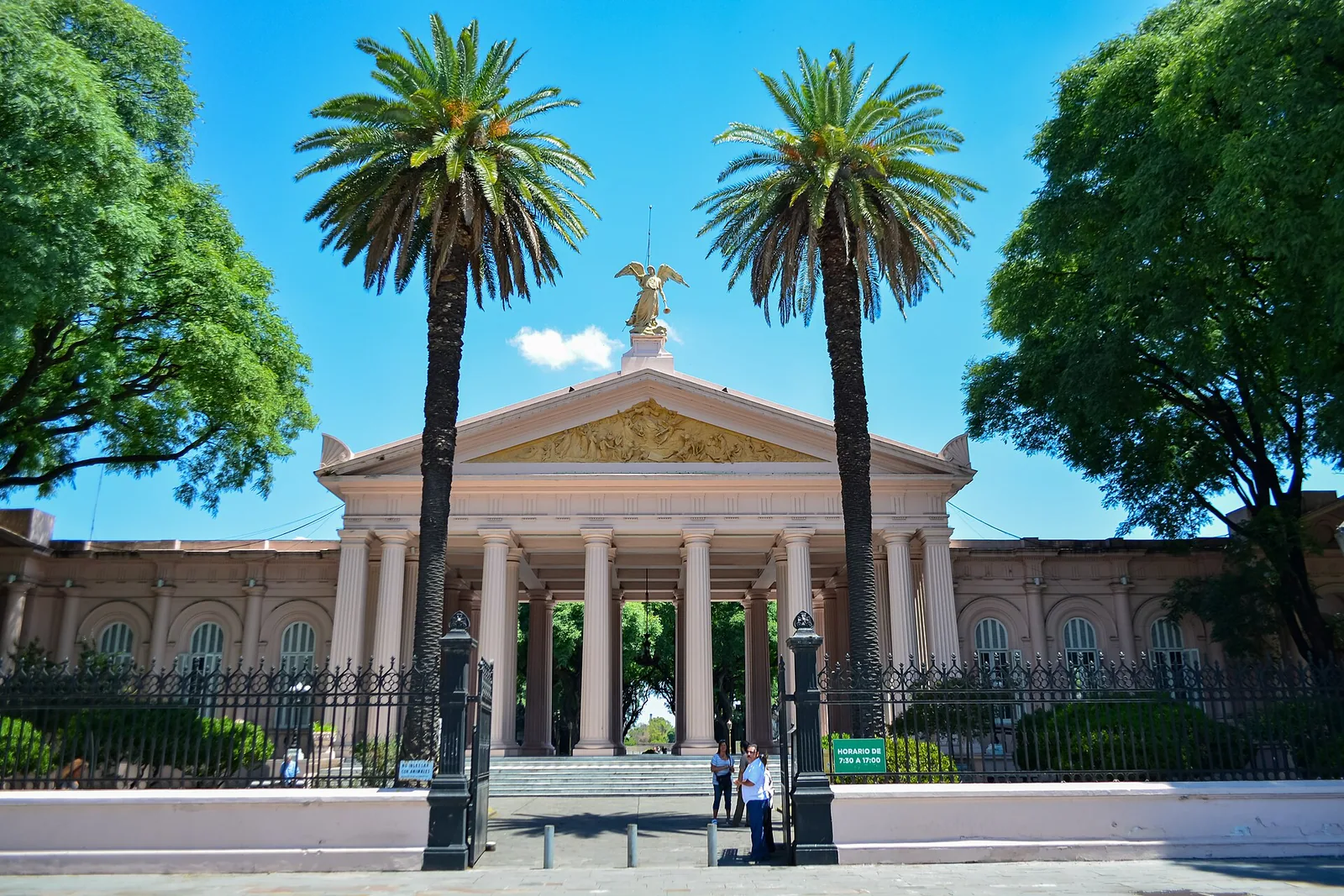
Chacarita Cemetery is the largest public cemetery in Buenos Aires and in all of Argentina, sprawling across 95 hectares (roughly 17 times larger than the famous Recoleta Cemetery) and considered "the Recoleta of the people": unlike the aristocratic Recoleta where presidents and the Argentine oligarchy rest, Chacarita holds the graves of Argentina's great popular artists — above all the icons of tango. Opened on November 14, 1871 as the city's logistical response to that year's tragic yellow fever epidemic (which killed 8% of Buenos Aires' population), the cemetery was laid out as a city of the dead with avenue-streets, numbered sectors and a monumental main gate on Av. Guzmán 680, opposite the Federico Lacroze station of subway line B and the Urquiza commuter trains. The most famous and pilgrimaged tomb is that of Carlos Gardel (Section 6, Block 33, plots 13-14): a mausoleum with a full-body bronze statue sculpted by Manuel de Llano in 1937 (two years after the cantor died at age 44 in the Medellín, Colombia plane crash on June 24, 1935), always with a lit cigarette in the bronze hand (visitors continuously replace it — part of the tango-fan ritual) and walls completely covered in plaques from admirers from every corner of the world. Beside Gardel rest the greats of Argentine tango: Aníbal Troilo "Pichuco" (legendary bandoneon player and composer), Osvaldo Pugliese (pianist and bandleader, icon of militant tango), Roberto Goyeneche "El Polaco" (the cantor of the 80s), Carlos Di Sarli (classic tango pianist), Hugo del Carril, Edmundo Rivero, Alfredo Le Pera (Gardel's lyricist, who died with him in Medellín), Mariano Mores, Juan de Dios Filiberto, Enrique Santos Discépolo. Cinema and theater: Tita Merello, Niní Marshall, Catita, Alberto Olmedo, Jorge Porcel, Sandro de América. Political figures: presidents Roque Sáenz Peña, Hipólito Yrigoyen, Lisandro de la Torre (Juan Domingo Perón rested here until 2006 when his remains were moved to the San Vicente mausoleum). Literary figures: Alfonsina Storni, Roberto Arlt, Macedonio Fernández. Boxing: Pascual Pérez, Nicolino Locche. Hours: open daily 7:00-17:00 (last entry 16:30). Free entry. Official Spanish-language guided tours from the City of Buenos Aires: Saturdays and Sundays at 11:00 and 15:00 from the main gate (free, no booking, arrive 15 min early). English guided tours via private operators USD 25-40. Recommended visit time: 1.5-2 hours for Gardel + the most important graves (3-4 hours for thorough visit). Wear comfortable shoes — it's 17x larger than Recoleta. Getting there: subway B line to Federico Lacroze (the subway exit leads straight to the main gate, 100 m). Also Urquiza commuter trains from Lacroze. Multiple bus routes (47, 71, 76, 87, 90, 93, 108, 111, 112, 113, 127, 161, 168, 176, 184). From the Microcenter: 25-35 min by subway. Completely safe during daytime hours with security personnel and police presence. Pair with a visit to Recoleta Cemetery to understand the dual social architecture of 20th-century Argentina.
Typical prices by category
| Item | Price |
|---|---|
| Cemetery entry | Free |
| Official Spanish guided tour (Sat/Sun) | Free |
| Private bilingual tour (operator) | USD 25-40 |
| Tango-themed tour (3 hrs) | USD 35-55 |
| Printed map at administration | Free (ask) |
| Recoleta + Chacarita combo (with guide) | USD 45-70 |
| SUBE subway card minimum top-up | USD 1 |
Self-guided visits and official Spanish tours are free. Private operators charge for themed tours.
The Must-See Graves
Carlos Gardel — Section 6, Block 33
The most famous grave in Argentina. Mausoleum with a full-body bronze statue sculpted by Manuel de Llano in 1937. The statue always has a lit cigarette in its hand (visitors keep replacing it). The walls are covered in plaques from fans worldwide, in Spanish, Italian, French, Japanese. Every June 24 (anniversary of his death in the 1935 Medellín plane crash) there's a mass pilgrimage with live tango singers. Gardel's mother Berta Gardés and his lyricist Alfredo Le Pera (who died in the same crash) rest with him. First mandatory stop.
Aníbal Troilo "Pichuco"
The most influential bandoneon player and composer of tango (1914-1975). His mausoleum is near Gardel's and usually has fresh flowers. Composed classics like "Sur" (lyrics by Homero Manzi), "La última curda", "Responso".
Osvaldo Pugliese
Pianist and bandleader of militant tango (1905-1995). The name "Pugliese" is superstitiously invoked by Argentine musicians before performances for good luck. His simple, elegant tomb reflects his personality. Composed "La Yumba", "Recuerdo", "Negracha".
Roberto Goyeneche "El Polaco"
The cantor of the 80s (1926-1994), with an unmistakable cracked voice. His renditions of "Naranjo en flor" and "Cafetín de Buenos Aires" are reference recordings. Modest tomb, often with visitors humming tangos.
Tita Merello
The great Buenos Aires actress and singer (1904-2002). Iconic film: "Mercado de Abasto" (1955). Sang "Se dice de mí". Tomb in the artists' section.
Sandro de América
Roberto Sánchez (1945-2010), the romantic 60s-70s teen idol. Italian descent, born in Banfield. Sold 8 million records. His grave is heavily visited by fans, usually with flowers and letters.
Alfonsina Storni
The great Argentine-Swiss poet (1892-1938). Suicide by walking into the sea at Mar del Plata; her poem "Voy a dormir" was her farewell. Simple grave. Inspired the song "Alfonsina y el mar" (Ariel Ramírez and Félix Luna).
Hipólito Yrigoyen
Argentine president (1916-1922 and 1928-1930), historic leader of the Radical party. Monumental mausoleum in the political-figures section. Annual homage on July 3 (death anniversary).
Book a Chacarita tour
Tango BA themed tour
Tango walking tour: Chacarita Cemetery (Gardel, Troilo, Pugliese) + Carlos Gardel House Museum + Abasto neighborhood + tango show. Full day.
Buenos Aires Cemeteries Tour
Recoleta + Chacarita in one day with bilingual guide. Compare 'aristocracy' (Recoleta) vs 'the people' (Chacarita) and the great tango figures. 5 hours.
BA tango tour with dinner-show
Chacarita visit + Gardel House + Abasto + dinner-show at a traditional tango venue (Café de los Angelitos or similar). 7 hours, dinner included.
Getting There & Walking the Cemetery
By subway / train
The easiest option: Subway line B to Federico Lacroze. The subway exit leads directly to the main cemetery gate, 100 m away. From downtown (Florida) it's 25 min. SUBE card needed. Urquiza-line trains terminate at Lacroze (next to the subway) — useful coming from the western suburbs.
By bus
15+ bus lines stop at or near the gate: 47, 71, 76, 87, 90, 93, 108, 111, 112, 113, 127, 161, 168, 176, 184. From Palermo: 71 or 168 (15 min). From Plaza de Mayo: 47 or 76 (30-40 min).
Self-guided walk
Pick up the printed map at the administration office (right of the main entrance). The map identifies sections and notable figures. To find Gardel: from the main gate, walk straight 300 m down the central avenue, turn left at the first major fork. It's signposted.
Official guided tour
Saturdays and Sundays at 11:00 and 15:00 from the main gate. Free, in Spanish, no booking (arrive 15 min early). 90 minutes. Recommended for historical context. Tours organized by the City of Buenos Aires tourism office.
What's Nearby
- Carlos Gardel House Museum — Jean Jaurés 735, Abasto (3 km, 12 min by Uber). USD 5 entry. Dedicated to the cantor's life.
- Abasto neighborhood — Carlos Gardel lived here. Murals, themed cafés, B-line subway "Carlos Gardel" station.
- Palermo — restaurants and cafés, 15 min by bus.
- Mercado de Abasto Shopping — historic central market converted to mall, food court (4 km).
- Café de los Angelitos — Rivadavia 2100, historic café with tango show (5 km).
- Recoleta Cemetery — for complementary visit (6 km).
Where to stay nearby (Chacarita / Almagro)
Hotels in Chacarita Buenos Aires
Compare prices on Booking, Hostelworld & more
Booking.com
Fitting Chacarita in Your BA Itinerary
Suggested itineraries for tango fans and culture lovers:
- Tango full day: Morning Chacarita (with 11:00 guided tour) → lunch in Abasto → afternoon Carlos Gardel House Museum → evening dinner-show at Café de los Angelitos.
- Pair with Recoleta: Recoleta Cemetery (morning) + lunch in Recoleta + Chacarita (afternoon 15:00 with guide) — fascinating social and architectural contrast.
- BA 4-5 day plan: Chacarita is best on day 3 or 4 once you've done the headline neighborhoods and want to go deeper into the culture.
More resources: complete tango guide for Buenos Aires, suggested itineraries, where to stay.