Aconcagua is the highest mountain in the Americas and in the Southern Hemisphere, standing at 6,961 meters above sea level. Located in the Aconcagua Provincial Park, 180 km from Mendoza city on Route 7 toward Chile, it attracts thousands of mountaineers from around the world every season. But you do not need to be an alpinist to enjoy it: the trek to Plaza de Mulas base camp is accessible to hikers in good physical condition, and the panoramic High Mountain excursion lets you see Aconcagua up close in a single day.
Quick facts: Aconcagua
- Altitude: 6,961 meters above sea level
- Location: Aconcagua Provincial Park, Route 7 (180 km from Mendoza)
- Season: November 15 to March 15
- Trekking permit (Plaza de Mulas): from USD 60 (foreigners, low season)
- Summit permit: from USD 450 (foreigners, low season) up to USD 950 (high season)
- 1-day panoramic excursion: from USD 59.40 with Civitatis
- Base camp trek: 3-5 days (round trip)
- Summit expedition: 15-20 days with acclimatization
Options to visit Aconcagua
Option 1: Panoramic High Mountain excursion (1 day)
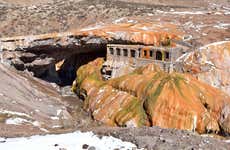
The most popular and accessible way. The Civitatis High Mountain excursion (USD 59.40 with 10% off) departs early from Mendoza and follows Route 7 through Potrerillos, Uspallata, Puente del Inca and the Aconcagua viewpoint. No special physical preparation is required and it is suitable for the whole family. It runs year-round (the route may close in winter due to snow). Rating 8.8/10 with thousands of reviews.
Option 2: Trek to Plaza de Mulas base camp (3-5 days)
For those wanting a more immersive experience, the trek to Plaza de Mulas base camp (4,370 m) is a spectacular adventure. You enter through the Horcones gorge, hiking through high mountain landscapes to reach the mountain's largest base camp. It requires a Provincial Park permit, good physical fitness and mountain trekking gear.
- Day 1: Mendoza to Confluencia (3,390 m) — 6-7 hours of hiking
- Day 2: Acclimatization day at Confluencia
- Day 3: Confluencia to Plaza de Mulas (4,370 m) — 7-9 hours
- Day 4: Day at Plaza de Mulas, panoramic views of the south face
- Day 5: Descent to Horcones and return to Mendoza
Option 3: Summit expedition (15-20 days)
The full ascent of Aconcagua is a high-mountain challenge reserved for mountaineers with prior altitude experience. The normal route (northwest) is the most traveled and "least technical," but requires excellent physical fitness, gradual acclimatization and professional gear. Guided expeditions cost between USD 5,000 and USD 10,000 depending on the company and level of service.
Aconcagua Provincial Park permits
All entry to Aconcagua Provincial Park requires a permit issued by the Mendoza Environment Secretariat. Permits are processed online through the official website and have differentiated prices:
Permit prices 2025-2026 (reference)
- Short trek (Confluencia): USD 30-40 (foreigners) / variable ARS (Argentines)
- Long trek (Plaza de Mulas): USD 60-100 (foreigners, varies by season)
- Summit permit low season (Nov-Dec): USD 450-600 (foreigners)
- Summit permit high season (Dec-Feb): USD 700-950 (foreigners)
- Argentines and residents: reduced rates (approx 30-50% less)
Aconcagua season
Aconcagua Provincial Park is officially open from November 15 to March 15. Within this period:
- Low season (Nov 15 - Nov 30 and Mar 1 - Mar 15): Cheaper permits, fewer people, but more unstable and colder weather.
- Mid season (Dec 1-14 and Feb 15-28): Good balance between price, weather and number of climbers.
- High season (Dec 15 - Feb 14): Best weather conditions but most expensive permits and highest concentration of expeditions.
What to bring to Aconcagua
For the base camp trek (not summit):
- Waterproof mountain trekking boots
- Layered clothing: thermal base layer, fleece, waterproof windbreaker
- SPF 50+ sunscreen and UV-protection sunglasses
- Trekking poles
- 40-50 liter backpack
- Sleeping bag rated to -10C (can be rented in Mendoza)
- Water bottle and purification tablets
- Hat and gloves