At the heart of the Sierras Grandes of Cordoba, more than 1,900 meters above sea level, a colossal gash splits the earth: the Quebrada del Condorito, an 800-meter-deep canyon that is the main nesting site of the Andean condor in Argentina's central sierras. Created in 1996, Quebrada del Condorito National Park protects 37,344 hectares of high-altitude grasslands, tabaquillo woodlands and geological formations that represent one of the most important mountain ecosystems in the country's interior. Reaching the rim of the canyon after walking across the high pampas and watching condors soar in silence — wings nearly 3 meters wide riding the thermal currents — is one of the most powerful wildlife moments Argentine nature has to offer. And entry is completely free.
Getting there — distances & times
| From | Distance | Flight | Bus | Drive |
|---|---|---|---|---|
| New York (JFK) | 8500 km | 11 h via Buenos Aires | — | — |
| Miami (MIA) | 7100 km | 9 h via Buenos Aires | — | — |
| Madrid (MAD) | 10000 km | 13 h via Madrid + AR domestic | — | — |
| Buenos Aires (EZE) | 700 km | 1 h 15 | 10 h | 8 h |
| Mendoza | 670 km | 1 h 10 | 9 h | 7 h |
| Iguazu (IGR) | 1100 km | 1 h 30 | — | — |
Month-by-month climate
| Month | Temp. | Rain | Crowds | Note |
|---|---|---|---|---|
| Jan | 19° / 31°C | 120 mm | Summer, peak season | |
| Feb | 18° / 30°C | 105 mm | ||
| Mar | 16° / 28°C | 90 mm | ||
| Apr | 12° / 25°C | 50 mm | ||
| May | 8° / 21°C | 20 mm | ||
| Jun | 5° / 18°C | 12 mm | ||
| Jul | 4° / 18°C | 10 mm | Winter break | |
| Aug | 6° / 21°C | 12 mm | ||
| Sep | 9° / 23°C | 30 mm | ||
| Oct | 13° / 26°C | 70 mm | ||
| Nov | 15° / 28°C | 95 mm | ||
| Dec | 18° / 30°C | 125 mm |
National Park Essentials
- Location: Sierras Grandes, access via Route 34 (Altas Cumbres) km 80
- Altitude: 1,900-2,300 meters above sea level
- Area: 37,344 hectares
- Entry: free (ranger registration required)
- Main trail: North Balcony, 9 km one way (3-4 hours)
- Canyon depth: 800 meters
- Best time: September to March for condors; avoid foggy days
- Tour from Cordoba: from USD 69 with Civitatis
The North Balcony Trail: The Headline Hike
The North Balcony trail is the park's main and most popular hike. It is a 9-kilometer one-way trek (18 km round trip) that starts at the ranger station on Provincial Route 34 and crosses the Sierras Grandes high pampas all the way to the rim of the canyon itself. The full round trip takes between 6 and 7 hours, so an early start is essential to finish the route in daylight.
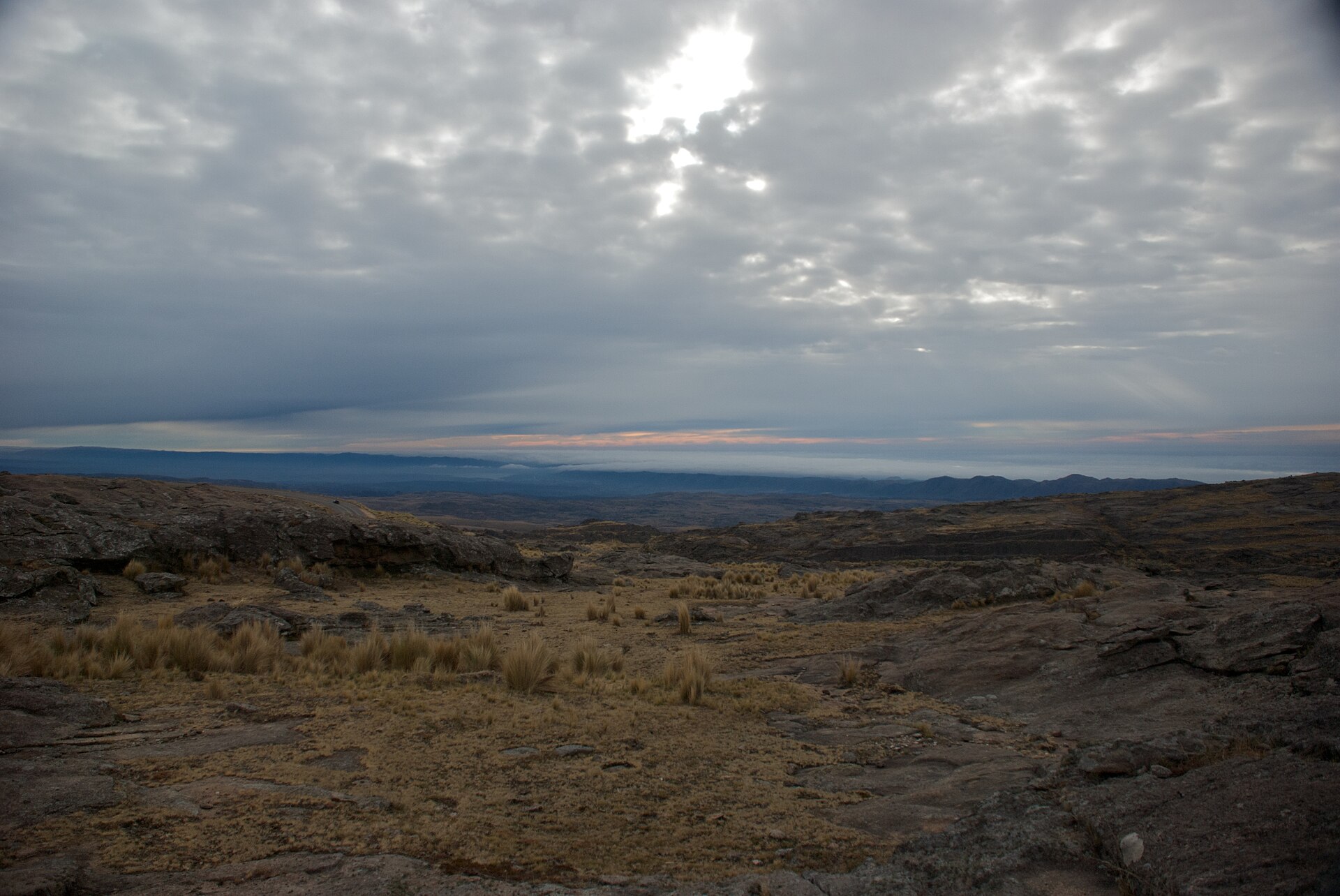
The first kilometers of the trail run through a landscape of rolling, open high-altitude grasslands, with sweeping views of the sierras in every direction. The vegetation is low and wind-resistant: native grasses, sierra ferns and patches of tabaquillo, a native tree with a twisted trunk that only grows above 1,500 meters. The trail is relatively flat for most of the route, making it accessible to walkers with reasonable fitness, although the altitude (1,900-2,100 meters) can produce some fatigue if you are not acclimated.
The hardest stretch comes at the end: a steep descent of around 200 meters of elevation drop along a rocky path leading to the North Balcony, a natural lookout right at the canyon edge. Here, the ground simply opens up and plunges into an 800-meter precipice. The vertigo is real and impressive. At the bottom of the canyon, barely visible, runs the Condorito river — the sculptor that has been carving this monumental gash for millions of years. The vertical canyon walls, with their exposed rock layers in shades of ochre, gray and red, are home to the breeding pairs of condors that nest on inaccessible ledges.
Condor Spotting: The Main Event
Reaching the North Balcony and sitting in silence to wait for the condors to appear is an exercise in patience that pays off with one of the most powerful wildlife experiences in South America. The Andean condor (Vultur gryphus) is the largest flying bird in the world, with a wingspan of up to 3.2 meters and a weight of up to 15 kilograms. Despite their imposing size, condors are silent gliders that ride the ascending thermal currents generated by the heating of the canyon walls, soaring upward without barely flapping their wings.
The Quebrada del Condorito hosts one of the most accessible condor colonies in the entire Andes. An estimated 80 to 100 individuals use the canyon as a nesting, resting and feeding area. From the North Balcony, you can watch condors glide just meters away, sometimes at the same height as the viewpoint or even below it, offering a unique and intimate perspective on these majestic birds. Adult males are recognizable by their white collar and fleshy crest (caruncle), while females are entirely dark-plumed.
The best hours for spotting are between 10:00 and 14:00, when the sun has warmed the canyon walls and the thermal currents peak. Condors begin to emerge from their roosts on the rock ledges, spreading their enormous wings and rising in ever-tighter spirals. A pair of strong binoculars or a telephoto lens dramatically improves the experience, although on many occasions the condors pass close enough to make out every detail with the naked eye.
Park Flora and Fauna
Although condors are the undisputed star, Quebrada del Condorito National Park protects a rich and diverse mountain ecosystem. The high-altitude grasslands (cumbre pampas) are the dominant landscape, where native grasses ripple in the wind, creating a green sea that shifts with the seasons: vivid green in spring and summer, gold in fall, and brown in winter. The tabaquillo (Polylepis australis) woodlands are remnants of vegetation that was once far more extensive and today survives only in wind-protected gorges.
Beyond the condors, the park's fauna includes the puma (rarely seen but present), the gray fox (often quite confident around the trails), the sierra lizard (an endemic species), several species of eagles and hawks, the peregrine falcon, and a remarkable diversity of grassland birds including the mourning sierra finch, the long-tailed meadowlark and the cinnamon-bellied ground-tyrant. The streams crossing the pampas are home to small endemic amphibians adapted to the cold mountain waters.
The park's vegetation changes dramatically with altitude. From 1,500 meters, small woods of tabaquillo and maiten alternate with tree ferns. Above 2,000 meters, vegetation thins to sparse grasses, lichens on the rocks and plants adapted to the cold, wind and intense solar radiation. In spring (September-November), wildflowers tint the pampas with colors that contrast against the deep blue sky of the high country.
How to Get to Quebrada del Condorito
The main access to the park is via Provincial Route 34, the famous Altas Cumbres Road connecting Villa Carlos Paz with Mina Clavero. The entrance is signposted at kilometer 80, around 55 kilometers from Carlos Paz (1 hour by car) and 50 kilometers from Mina Clavero. The route is paved and in good condition but winding and mountainous, with tight bends and frequent morning fog patches.
There is no public transport that reaches the park entrance directly. Your options are: your own or a rental car (the most practical; free parking is available at the entrance), a tour from Cordoba with Civitatis that includes a guided trek to the North Balcony (USD 69, full day), or an excursion from Carlos Paz to the Altas Cumbres (USD 45, with a stop at the park). Self-drivers should fill up in Carlos Paz before starting the climb.
Park hours run 8:00 to 14:00 (varies by season; confirm with National Parks). Rangers register every visitor and provide updates on trail conditions and the day's weather. Respecting the schedule matters: summer thunderstorms at altitude can be dangerous, and dense fog can complicate orientation on the trail.
Other Trails in the Park
While the North Balcony is the headline trail, the park has other options. The La Pampa interpretive trail (2 km, 45 minutes) is a short, easy walk near the ranger station, ideal for visitors who can't take on the longer hike. It features interpretive signs about the park's flora, fauna and geology, and offers partial views of the high-altitude pampas.
The South Balcony is an alternative to the North Balcony that offers a different perspective on the canyon, although it requires more time and is less visited. For more ambitious itineraries, rangers can advise on alternative trails and crossings that demand more experience and planning. Any hiking beyond the main trails requires prior consultation with the rangers.
What to Bring to the Park
Preparation is key to enjoying a visit to Quebrada del Condorito National Park. The list of essentials includes: water (minimum 2 liters per person — there is nowhere to refill), trekking shoes with good soles (the trail has rocky sections), SPF 50 sunscreen (UV radiation at 2,000 meters is intense), a hat and sunglasses, a windproof layer (it can be cold and windy even in summer), energy snacks (cereal bars, nuts, chocolate) and binoculars for condor spotting.
Pack out everything you bring in (the park follows a "what you bring in, you take out" policy) and never feed wildlife. Trekking poles are recommended for the descent to the North Balcony. A camera with a strong zoom or a telephoto lens dramatically improves the photography experience with the condors. Carry food for a midday meal on the trail — the full hike takes most of the day and there are no food services inside the park.