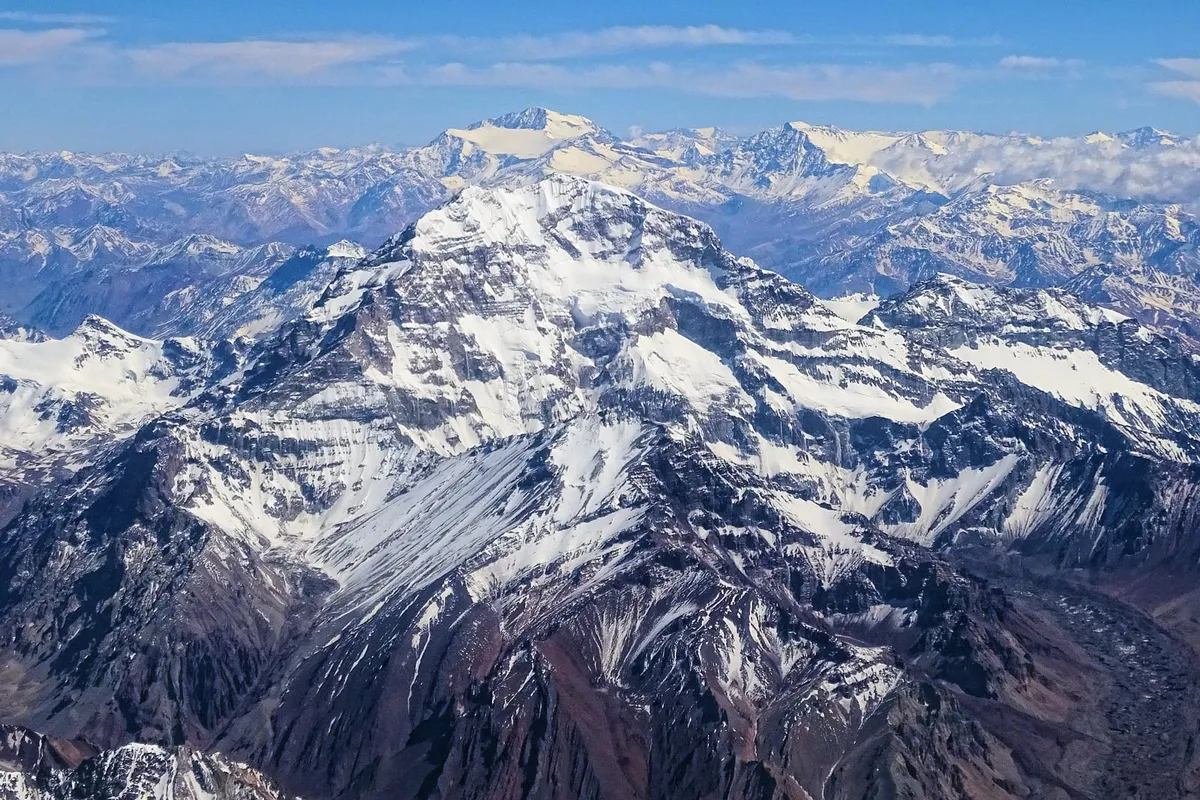
Mount Aconcagua is the highest peak in the Americas at 6,961 meters above sea level (consensus measurement from Argentina's IGN and Chile's IGM after GPS surveys in 2012), located entirely in Mendoza province, Argentina, in the Las Heras department, 165 kilometers west of Mendoza city and 15 kilometers east of the Chilean border, in the Principal Cordillera of the Andes. It is also the highest summit in the southern hemisphere, the highest in the world outside the Asian continent, and one of the Seven Summits (the highest peaks on each of the seven continents: Everest in Asia, Aconcagua in the Americas, Denali in North America, Kilimanjaro in Africa, Elbrus in Europe, Mount Vinson in Antarctica, Puncak Jaya in Oceania) — the bucket-list goal of the world's most experienced mountaineers. Its name comes from Quechua "Ackon Cahuak" ("Stone Sentinel") or Aymara "Kon-Kawa" ("Snowy Mountain"), reflecting the ritual importance it held for indigenous peoples. The first documented ascent was made by Swiss climber Matthias Zurbriggen on January 14, 1897 via the north route (today's Normal Horcones Route). Aconcagua is an extinct volcano whose last major eruption was over 150 million years ago (Jurassic period), today shaped by glaciers descending from its summit: Horcones Glacier, Upper Horcones, Polacos and Relinchos. Protected by the Aconcagua Provincial Park (71,000 hectares created on October 28, 1983 by the province of Mendoza), the peak sees approximately 7,000 climbing attempts per season (November-April) with a 30-40% summit success rate in average years. The official 2025-2026 season runs from November 1 to April 30 with the following permits: climbing without assistance via Horcones Route USD 1,640 (foreigners) / USD 1,270 (Latin Americans) / ARS 270,000 (Argentines); Vacas Route (Polish) USD 2,000 / USD 1,580 / ARS 330,000; 3-7 day trek to Plaza de Mulas USD 400; day trek to Confluencia USD 55. Permits are mandatory and sold through licensed operators (Grajales, Aconcagua Expeditions, Andes Vertical, Inka Expediciones). For non-mountaineers the accessible experience is the day trek to Confluencia (3,400 m, 6 km from the park entrance at Horcones at 2,950 m, 6 hours round-trip, moderate difficulty, with a direct view of Aconcagua's south face) — ideal if you want to experience the giant's environment without the technical demands of summiting. Main access is Horcones / Puente del Inca (2,720 m) on RN 7 (Pan-American Highway to Chile), 165 km west of Mendoza city, 3 hours by car. Full ascents take 18-21 days with acclimatization, with total costs of USD 4,500-8,500 including IFMGA guide, food, gear and mule porterage. Statistically it is one of the world's most dangerous mountains: 3-5 climbers die each season (cumulative 150+), mainly from high-altitude cerebral or pulmonary edema, hypothermia or falls. Minimum requirements: prior experience above 5,000 m, optimal physical condition, mandatory rescue insurance, proper acclimatization.
Getting there — distances & times
| From | Distance | Flight | Bus | Drive |
|---|---|---|---|---|
| Mendoza city | 165 km | — | 4 h | 3 h |
| Uspallata | 85 km | — | 2 h | 1 h 30 |
| Puente del Inca | 4 km | — | — | 10 min |
| Penitentes | 12 km | — | — | 20 min |
| Las Cuevas (Chile border) | 15 km | — | — | 30 min |
| Santiago de Chile | 235 km | — | — | 5 h + border |
| Buenos Aires (flight to MDZ) | 1050 km | 1 h 40 + 3 h drive | — | — |
Typical prices by category
| Item | Price |
|---|---|
| Foreigner climbing permit (Horcones) | USD 1,640 |
| Latin American climbing permit | USD 1,270 |
| Argentine climbing permit | ARS 270,000 |
| Vacas Route permit (foreigner) | USD 2,000 |
| Long trek Plaza de Mulas (foreigner) | USD 400 |
| Day trek Confluencia (foreigner) | USD 55 |
| Day trek Confluencia (Argentine) | ARS 25,000 |
| All-inclusive guided ascent | USD 4,500-8,500 |
| Mandatory rescue insurance | USD 80-150 |
| Hotel Puente del Inca (base) | USD 70-120 |
| Day excursion from Mendoza | USD 85-130 |
Official 2025-2026 season prices. Early bird (before Aug 29, 2025): 10% off.
Experience Options — Choose Your Aconcagua
Option 1: Day Excursion (no trekking)
Profile: tourists without trekking experience, families with children, photo seekers.
What it includes: from Mendoza city, full-day bus tour through the High Mountains: Puente del Inca (natural thermal bridge, 2,720 m), Aconcagua viewpoint from the highway (south face view from 3 km away), Las Cuevas, Chilean border. No park entry (no permit required). 10-12 hours. USD 85-130 per person.
Operators: Bus Panorámico, Mendoza Tours, Aconcagua Viajes.
Option 2: Day Trek to Confluencia (1 day)
Profile: hikers in good shape, no high-altitude experience required, who want to actually step inside Aconcagua Park.
What it includes: short trek permit (USD 55 foreigner), 6 km hike from Horcones entrance (2,950 m) to Confluencia camp (3,400 m), 6 hours round-trip, moderate difficulty, clear trail. Direct view of Aconcagua's south face. Prior acclimatization recommended (at least 1 night at Puente del Inca, 2,720 m).
When: November to April.
Optional guide recommended for first-timers (USD 100-180).
Option 3: Long Trek to Plaza de Mulas (3-7 days)
Profile: experienced trekkers (4,000m+ background), good fitness, who want to reach base camp.
What it includes: long trek permit (USD 400 foreigner), 3 days approach to Plaza de Mulas (4,300 m, historic base camp), 1 day exploration and acclimatization, 2 days return. 25 km each way passing Confluencia, Playa Ancha, optional Nido de Cóndores. Possibility to see climbers preparing to summit.
Porterage: mules or porters. USD 40-80/day.
Guide: highly recommended. USD 180-280/day with IFMGA guide.
Option 4: Full Summit Ascent (18-21 days)
Profile: mountaineers with 5,000m+ experience, optimal physical condition, prepared for extreme conditions.
What it includes: climbing permit (USD 1,640 foreigner), approach to Plaza de Mulas, progressive acclimatization (Nido de Cóndores, Berlin, Plaza Cólera), summit attack (10-16 hours from Berlin to 6,961 m), full descent. Routes: Normal (Horcones, longer and less technical) or Polacos (Vacas, more technical, less crowded, USD 2,000).
Recognized operators: Grajales Expeditions, Aconcagua Expeditions, Andes Vertical, Inka Expediciones, Fernando Grajales, Alpenland.
Total all-inclusive cost: USD 4,500-8,500 per person (permit, IFMGA guide, meals, tents, porterage).
Aconcagua Experiences
High Mountain Full Day from Mendoza
Panoramic excursion: Puente del Inca, Aconcagua viewpoint (south face), Las Cuevas, Chile border. No trekking. 10 hours.
Confluencia Day Trek
Permit + 6 km hike to Confluencia (3,400 m), with certified guide and box lunch. Direct view of south face. Acclimatization required.
Plaza de Mulas 7-day Trek
Trekking expedition to base camp (4,300 m). IFMGA guide, mule porterage, meals, tents. Requires 4,000m+ prior experience.
Around Aconcagua Park
Puente del Inca (natural base)
4 km from Horcones, Puente del Inca is a geological curiosity: a natural arch over the Cuevas River formed by mineral deposits from underground thermal waters. Beautiful yellow, orange and red colors. Ruins of the former Hotel Puente del Inca (destroyed by an avalanche in 1965) are still there. Entry USD 3-5. A natural pairing with Aconcagua.
Penitentes (ski center)
12 km from Puente del Inca, Penitentes is Mendoza's mid-sized ski resort. June-October season, 28 runs, ideal for beginners and families. In summer it operates as a base for trekking and mountain biking.
Climbers' Cemetery
The Cementerio de los Andinistas at Puente del Inca is a moving tribute to the many mountaineers (local and international) who have lost their lives attempting Aconcagua. Plaques with names, dates and nationalities.
How to Get There
From Mendoza city: 165 km on RN 7 (Pan-American Highway toward Chile). 3 hours by car. By regular bus: Empresa Uspallata, USD 15-25, 4 hours, with stops in Uspallata, Penitentes, Puente del Inca and Horcones.
By rental car: recommended for flexibility. RN 7 fully paved. Tolls USD 5-8. In winter (June-September) bring snow chains.
From Chile: from Santiago via Chile's Route 60, Los Libertadores pass (Cristo Redentor), 235 km, 5-6 hours including border crossing. Customs hours: 24/7 in season, reduced in winter.
See also: Mendoza hub, High Mountains, Uspallata, Puente del Inca, Penitentes, Cristo Redentor.