Bodega Trapiche is one of the oldest and largest wineries in Argentina, founded in 1883 in Coquimbito, Maipu, by Tiburcio Benegas — a former governor of Mendoza Province who had bought the original Finca El Trapiche estate the previous year. The historic 1883 cellar, with its towering brick walls, vaulted ceilings and original Italian-imported foudres, is one of the most photographed industrial-heritage buildings in Argentina and is now a designated National Historic Monument. Trapiche sits 18 km east of Mendoza city in the heart of Maipu, on the Maipu bike circuit and within walking distance of several smaller producers and historic olive-oil mills. The brand has been part of the Penaflor Group since 1989 — Argentina's largest wine company, which also owns Finca Las Moras, Mascota Vineyards and Trivento — and it is currently the country's biggest wine exporter, present in 80+ markets. Total annual production runs over 30 million bottles. Despite the industrial scale, the premium tier under chief winemaker Daniel Pi has earned consistent international recognition: the icon Iscay Malbec-Cabernet Franc blend is regularly scored 94-96 points by Wine Advocate and Tim Atkin MW, and the Single Vineyard Malbec line was a pioneering parcel-selection program in Argentina, with the Finca Las Palmas, Finca Coletto and Finca Suarez wines scoring 92-94 points across the last decade.
Why visit Trapiche
If you want to combine architectural heritage with a serious tasting, Trapiche is the most rewarding stop in Maipu. The 1883 brick cellar feels closer to a Tuscan industrial monastery than a contemporary winery — vaulted ceilings, exposed beams, original concrete fermentation pools and a row of 130-year-old oak foudres still in occasional use. Most premium experiences include a walk through the original warehouses where the wines used to be barreled by horse-drawn rail cars, and the ground floor was redesigned in 2007 by architects Bormida & Yanzon to house tasting salons, the Espacio Trapiche restaurant and an exhibition area. The result is a working winery where you can taste 140 years of Argentine industrial history alongside modern Malbec.
The other reason to come is value. Trapiche keeps its Classic tour under USD 30 — competitive with Maipu neighbors like Familia Zuccardi and Tempus Alba — while still giving you access to icon-tier wines on the Premium and Iscay verticals. For travelers on a half-day from Mendoza city or a Maipu bike-circuit itinerary, the price-to-quality ratio is hard to beat. Espacio Trapiche, the on-site restaurant run by chef Lucas Bustos, is also one of the best-reviewed winery dining rooms in Maipu, with a focus on regional Argentine cooking and a deep tasting-menu wine list.
The wines
Trapiche Estate (entry)
The everyday range — Estate Malbec, Cabernet Sauvignon, Chardonnay — sourced across Mendoza estates. Argentina retail USD 6-10. Bright, varietally true, the most-sold Trapiche line and the workhorse of Argentine wine exports for two generations. A reliable benchmark for what entry Malbec tastes like.
Oak Cask & Medalla
The mid-tier line. Oak Cask Malbec (USD 12-18) is aged 10 months in American oak. Medalla Malbec (USD 18-28) is the historic flagship of the brand, dating from 1983, with consistent 91-93 point scores at Tim Atkin MW. Both lines source from selected high-altitude Lujan de Cuyo and Maipu parcels.
Single Vineyard (super-premium)
Pioneering parcel-selection program launched in 2003 that highlights specific blocks: Finca Las Palmas (Vista Flores), Finca Coletto (Tupungato) and Finca Suarez (Altamira). USD 30-50. Lower yields, longer oak ageing, real sense of place. Some of the most affordable single-vineyard Malbec from Argentina at this quality level.
Iscay (icon)
The flagship blend, roughly 60% Malbec and 40% Cabernet Franc, made only in years that meet a strict quality threshold. USD 60-100 in Argentina, often USD 150+ in export markets. Aged 18-22 months in new French oak. The 2014 vintage was awarded 96 points by Wine Advocate and is widely cited as one of the best Cabernet Franc-led blends ever made in Argentina.
Tasting & tour options
| Experience | Price (USD) | Duration | What's included |
|---|---|---|---|
| Classic tour | 20-30 | 1 hour | Historic cellar walk + 4-wine flight (Estate and Oak Cask) |
| Premium Medalla & Single Vineyard | 35-50 | 1h30 | Tour + 5-wine flight focused on premium parcels |
| Iscay vertical | 55-75 | 1h30 | 3-4 vintages of the icon Iscay Malbec-Cabernet Franc, sommelier led |
| Espacio Trapiche lunch | 100-140 | 3 hours | 5-course paired lunch by chef Lucas Bustos with premium tier wines |
Reservations open via trapiche.com.ar 60-90 days ahead; the Espacio Trapiche lunch and Iscay vertical sell out fastest in summer.
Book your Trapiche visit
 Best seller
 Wine Tour from Mendoza (3 wineries)
Full-day small-group tour with hotel pickup, three-winery circuit including Maipu and Lujan de Cuyo icons. Tastings and lunch included.
Private Driver — Maipu
Door-to-door private transfer with English-speaking driver. Drink freely, return to hotel safely. Up to 4 passengers.
Hotels in Maipu & Mendoza
Compare boutique winery hotels and city stays near Trapiche. Free cancellation on most properties.
How to get there
Trapiche sits 18 km east of Mendoza city in Coquimbito, Maipu. Coming from downtown the route is RN 7 east to the Maipu turnoff, then local streets through the wine-and-olive-oil corridor — about 25 minutes door-to-door. There is no direct public transport but the Maipu bike circuit passes nearby, so you have four realistic options:
- Self-drive: rental cars from Mendoza airport run USD 55-80/day. Free parking on site. Only viable if a non-drinking person in your group can drive home.
- Uber or remis: one-way Uber costs USD 8-14 (Maipu has strong Uber coverage given the proximity to the city); a remis booked round-trip with a wait is USD 35-55.
- Wine tour with transfer: operators like Mendoza Wine Tours, MendoVino, Trout & Wine and Ampora Wine Tours run small-group circuits (USD 130-200 per person, three wineries plus lunch) and private full-day options (USD 280-450). This is the easiest path for first-time visitors.
- Bike circuit: Maipu has a flat, well-marked bike route connecting Trapiche with Familia Zuccardi (Maipu, not Valle de Uco), Tempus Alba and the local olive mills. Bike rentals from USD 15/day at Maipu bus terminal.
If you are coming from Lujan de Cuyo, plan 30 minutes by car. See the full getting-there guide for airport transfers and bus options.
Best time to visit
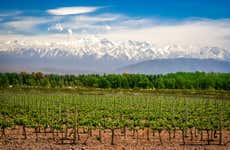
Harvest (vendimia, February-April) is the peak experience — Maipu harvests earlier than Lujan de Cuyo or Valle de Uco because of lower altitude, so you can see grapes coming in by mid-February. Daytime temperatures sit at 26-32 C and nights are warm. Spring (October-November) rivals it: rose bushes (planted as biological indicators of vine health) bloom along every row and the Andes still hold snow. Summer (December-February) is hot (30-35 C) and very busy on the bike circuit — book extra early. Winter (June-August) is the contrarian choice: bare vines, dramatic Andes light, smaller groups, and the historic 1883 cellar feels especially atmospheric with the cold outside. The winery is open Monday-Saturday year-round; Sundays remain closed.
Where to eat nearby
Maipu has a strong cluster of winery and farm-to-table restaurants:
- Espacio Trapiche — on-site restaurant by chef Lucas Bustos, regional Argentine cooking with deep wine list. USD 100-140 with paired wines.
- Casa del Visitante (Familia Zuccardi Maipu) — chef Maria Paz Zuccardi's family-style Argentine lunch, 10 minutes from Trapiche. USD 75-110.
- Tempus Alba — rooftop tapas with vineyard views, 15 minutes south. USD 45-65.
Where to stay
For a Trapiche-focused itinerary, the smartest base is Mendoza city itself (15-20 minutes from the winery) or one of the boutique Maipu lodges. Top options include Club Tapiz (USD 220-380), Posada Cavieres (USD 180-280) and Casa Glebinias (USD 200-340). For a Lujan de Cuyo or Valle de Uco base with day trips to Maipu, see Cavas Wine Lodge (Relais & Chateaux, USD 550-900) or The Vines Resort & Spa (USD 580-1,100). See our full Mendoza accommodation guide for neighborhood breakdowns.
Combine with other top wineries
A two- or three-day Mendoza wine itinerary typically pairs Trapiche with a Lujan de Cuyo or Valle de Uco icon to balance heritage and high-altitude. Top combinations:
- Catena Zapata — most-awarded Argentine winery, 35 minutes from Trapiche.
- Zuccardi Valle de Uco — World's Best Vineyard 2020/2022/2023, full-day from Mendoza.
- Lagarde — Forbes #5 in 2024, 40 minutes south.
- Luigi Bosca — historic 1901 family producer with century-old ungrafted vines, in Lujan de Cuyo.