The Serranias del Hornocal, commonly known as the 14-Color Mountain (Cerro de los 14 Colores), is an extraordinary geological formation located 25 kilometres from Humahuaca in the province of Jujuy, northwestern Argentina. At an altitude of 4,761 metres above sea level, this sedimentary massif displays a palette of at least fourteen distinct hues ranging from chalky white and sulphur yellow to ferruginous red, emerald green and deep violet. The formation originated over 600 million years ago, when successive layers of marine sediments, clays, sandstones, limestones and minerals containing iron, sulphur and copper were deposited on an ancient ocean floor. The Andean orogeny — the collision of the South American and Nazca tectonic plates — folded these originally horizontal strata into the jagged saw-tooth ridges that today fan out like a giant polychromatic display. The result is one of the most spectacular geological landscapes in South America and an unmissable destination for travellers exploring the Quebrada de Humahuaca, a UNESCO World Heritage Site since 2003.
Getting there — distances & times
| From | Distance | Flight | Bus | Drive |
|---|---|---|---|---|
| Buenos Aires (EZE) | 1500 km | 2 h 20 | 20–22 h | 15–17 h |
| New York (JFK) | 9400 km | 12 h + 2 h 20 layover | — | — |
| Madrid (MAD) | 11300 km | 14 h + 2 h 20 layover | — | — |
| São Paulo (GRU) | 2800 km | 4 h 30 | — | — |
| Córdoba | 890 km | 1 h 30 | 11–13 h | 9–10 h |
| Mendoza | 1200 km | 2 h | 17–19 h | 13–15 h |
Month-by-month climate
| Month | Temp. | Rain | Crowds | Note |
|---|---|---|---|---|
| Jan | 16° / 28°C | 180 mm | Rainy summer | |
| Feb | 15° / 27°C | 155 mm | ||
| Mar | 14° / 26°C | 110 mm | ||
| Apr | 11° / 24°C | 30 mm | Dry season starts | |
| May | 8° / 22°C | 8 mm | ||
| Jun | 5° / 20°C | 3 mm | ||
| Jul | 4° / 20°C | 3 mm | Winter break | |
| Aug | 6° / 22°C | 5 mm | ||
| Sep | 9° / 25°C | 10 mm | Clear skies | |
| Oct | 12° / 27°C | 25 mm | ||
| Nov | 14° / 28°C | 60 mm | ||
| Dec | 16° / 28°C | 140 mm | Holidays |
Typical prices by category
| Category | Budget | Mid-range | Luxury |
|---|---|---|---|
| Hotel/night | USD 15–25 | USD 50–90 | USD 150–350 |
| Food/day | USD 12–18 | USD 25–40 | USD 60–120 |
| Day tour | USD 40–55 | USD 60–90 | USD 120–200 |
| Car rental/day | USD 30–45 | USD 50–70 | USD 90–150 |
Approximate ranges in USD as of April 2026. May vary with Argentine peso exchange rate.
Important tip
The Hornocal viewpoint sits at 4,761 metres. Do not go directly from sea-level cities. Acclimatize for at least 1-2 days in Humahuaca (2,936m) or Tilcara (2,461m) before the excursion. Bring coca leaves, plenty of water and warm layers even in summer.
Key facts
- Viewpoint altitude: 4,761 m a.s.l.
- Distance from Humahuaca: 25 km (dirt road)
- Travel time: 45-60 min by 4x4
- Best season: May to October
- Best light: morning (8-11 AM)
- 4x4 excursion price: USD 30-50
- Entry fee: free
- Recommended vehicle: 4x4 or high-clearance truck
What exactly is Hornocal: geology of the 14 colours
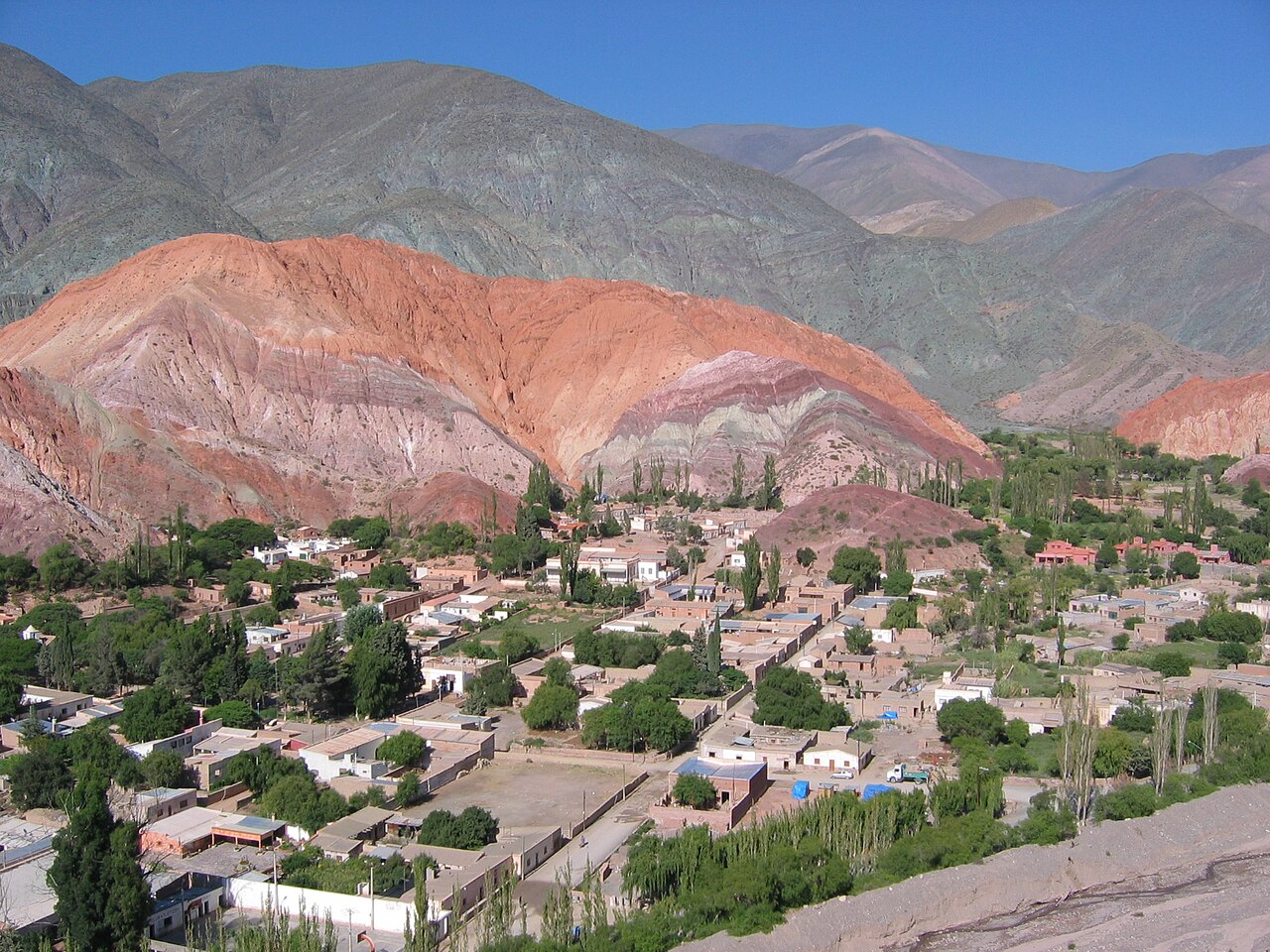
Hornocal is part of the Yacoraite Formation, a set of Cretaceous-Paleogene sedimentary rocks extending across the Puna and the Quebrada de Humahuaca. What makes it unique compared to other multi-coloured formations in the region — such as the Seven-Colour Hill in Purmamarca or the Painter's Palette in Maimara — is the number and intensity of its chromatic bands. While Purmamarca displays seven predominant colours, Hornocal unfurls at least fourteen, with subtle transitions that shift depending on the time of day and the angle of sunlight.
Each colour has a specific mineral origin. The intense reds and maroons come from iron oxides (hematite and goethite). Yellows and ochres are produced by limonite and sulphur. Greens correspond to copper compounds and chlorite. White tones are limestones and gypsum. Violets and magentas result from the mixture of manganese oxides with clays. Dark greys contain slates and organic-rich shales. This mineral diversity, compressed and folded over millions of years of tectonic activity, generates the visual spectacle visible from the viewpoint today.
The zigzag formation — those pointed crests resembling saw teeth — is caused by the intense folding of originally horizontal layers. Differential erosion, where softer layers wear away faster than harder ones, accentuates the contrasts between the different colour strata. The result is a geological structure that looks hand-painted but is entirely the product of natural processes spanning hundreds of millions of years.
How to get to Hornocal from Humahuaca
The starting point for visiting Hornocal is the town of Humahuaca (2,936 m), the northernmost town of the Quebrada de Humahuaca accessible by paved road. From Humahuaca's main square, a 25 km dirt road climbs through the Quebrada de Hornocal, a narrow valley flanked by colourful hills that serves as a preview of the final spectacle.
By 4x4 excursion (recommended)
The most comfortable and safest way to reach the viewpoint is to hire a 4x4 excursion in Humahuaca. Several agencies and local drivers offer the service. The price is USD 30-50 per person and includes the round-trip transfer, a 30-45 minute stop at the viewpoint, and most drivers provide a basic geological explanation. The total excursion lasts 2.5-3 hours. Departures in the morning (between 8 and 10 AM, ideal for light) and also in the afternoon. Book the day before at Humahuaca's tourism office or at agencies on the main street.
Full-day excursions from Salta city or San Salvador de Jujuy that cover the entire Quebrada de Humahuaca plus Hornocal are also available. These cost USD 60-90 per person and make for a long day (12-14 hours) but are convenient if you prefer not to drive.
By private vehicle
If driving your own car, you need a vehicle with good ground clearance. A 4x4 or pickup truck is strongly recommended. The road has steep gradients (up to 15%), loose gravel, narrow sections without guardrails above 4,000 metres, and tight switchbacks. A low sedan should not attempt this road. Even with a 4x4, drive slowly and carefully: the combination of altitude, narrow road and lateral precipices demands constant attention. There is no mobile phone signal for most of the route. Carry a spare tyre, water and warm clothing.
Road conditions by season
During the dry season (May-October) the road is usually in acceptable condition. During the rainy season (December-March) there can be landslides, washouts and impassable mud sections. Before heading up, check road conditions at Humahuaca's tourism office or ask local drivers. If it has rained recently, the road may be closed even during dry season. Caution always takes priority.
The Hornocal viewpoint: what to expect
The main viewpoint is marked by a sign and a small dirt parking area. From there, the view is head-on and panoramic: the multi-coloured ridges of Hornocal unfold from left to right like a geological wall with saw-tooth crests. The sheer breadth of the view is breathtaking — the massif extends for several kilometres.
There is no infrastructure at the viewpoint: no safety railings, toilets, water or shelter. It is an open natural space at 4,761 metres altitude. Wind can be fierce and the temperature, even in summer, can drop to 0 degrees C or below. Bring a windbreaker jacket, hat, gloves and SPF 50+ sunscreen (UV radiation is extreme at this altitude).
The typical stay at the viewpoint is 30-45 minutes. This is enough time to take in the landscape, shoot photographs and enjoy the absolute silence of the high mountains. Some visitors experience mild altitude sickness symptoms (headache, fatigue, shortness of breath). If symptoms worsen, descend immediately.
Photography tips for Hornocal
Hornocal is a photographer's dream, but capturing the magnitude of the colours requires planning:
- Golden hour morning (8-10 AM): Low-angle morning light strikes the ridges directly and maximizes colour saturation. Most iconic Hornocal photos are shot at this hour. The morning excursion is essential for photographers.
- Wide-angle lens: The massif is enormous. A 16-35mm lens (or phone panorama mode) is ideal for capturing the full extent. A telephoto (70-200mm) lets you isolate sections showing layer details.
- Polarizing filter: Reduces reflections from gravel and minerals, intensifies colours and darkens the blue sky. The most useful filter for this type of geological landscape.
- Tripod: At 4,761 metres, even steady hands can shake from lack of oxygen. A lightweight tripod ensures sharpness, especially with telephoto lenses.
- Drones: Check current ANAC (Argentina's civil aviation authority) regulations for drone flights in protected areas. In general, recreational drone flights are allowed outside airport zones and national parks, but the extreme altitude significantly reduces battery life and lift. Drone flights at 4,700m are technically challenging.
- Equipment protection: Dust, wind and sudden temperature changes can affect cameras and lenses. Carry a sealed bag or protective cover.
Altitude precautions: dealing with soroche
At 4,761 metres, atmospheric pressure is approximately 55% of what it is at sea level. Oxygen concentration is proportionally lower. The human body needs time to adapt to these conditions through a process called acclimatization.
Acute mountain sickness (known locally as apunamiento or soroche) can affect anyone regardless of fitness level. Mild symptoms include headache, fatigue, nausea, loss of appetite and insomnia. Moderate symptoms add vomiting, disorientation and severe shortness of breath. Severe cases (pulmonary or cerebral oedema) are medical emergencies requiring immediate descent.
Recommended acclimatization protocol
- Spend at least 1-2 nights in Humahuaca (2,936m) or Tilcara (2,461m) before ascending to Hornocal.
- Stay constantly hydrated: drink at least 3 litres of water per day.
- Chew coca leaves or drink coca tea (coqueo): the traditional Andean remedy that genuinely helps.
- Avoid alcohol and heavy meals in the 24 hours beforehand.
- At the viewpoint: move slowly, avoid running or sudden exertion.
- If symptoms worsen: descending is the only effective treatment.
- Consult a doctor before the trip if you have cardiac or respiratory conditions.
Best time to visit Hornocal
The ideal season is the dry season from May to October. During these months skies are clear most of the time, rainfall is virtually non-existent, and colour visibility is at its peak. Mornings tend to be completely cloud-free, with cloud build-up only in the afternoon.
- May-June: Excellent. Sunny days, cold but bearable temperatures. Low tourist numbers.
- July: Winter holidays. Flawless skies but very cold (-10 to -15 degrees C at the viewpoint). Higher demand for excursions.
- August-September: Optimal. Cold starts to ease, days grow longer and morning light is magnificent.
- October: Transitional. Warmer days but the first spring thunderstorms may appear in the afternoon.
- November-March: Rainy season. Road may be closed. Overcast skies hide the colours. Not recommended.
- April: End of rains, road recovering. Can be good if the rains ended early.
Combining Hornocal with the Quebrada de Humahuaca
Hornocal is the perfect complement to a trip through the Quebrada de Humahuaca. The classic Quebrada itinerary (from Salta or San Salvador de Jujuy) visits Purmamarca (Seven-Colour Hill), Tilcara (Pucara fortress, Garganta del Diablo), Maimara (Painter's Palette) and Humahuaca (Independence Monument, Serranias del Hornocal).
A recommended 3-4 day itinerary combining everything:
- Day 1: Salta or Jujuy to Purmamarca (Seven-Colour Hill, craft market). Overnight in Purmamarca or Tilcara.
- Day 2: Tilcara (Pucara, Garganta del Diablo) to Maimara to Humahuaca (Independence Monument). Overnight in Humahuaca.
- Day 3: Morning excursion to Hornocal. Free afternoon in Humahuaca. Overnight in Humahuaca or back to Tilcara.
- Day 4: Salinas Grandes (half-day excursion from Purmamarca) then return to Salta or Jujuy.
Hornocal vs Purmamarca's Seven-Colour Hill
Both are multi-coloured mountains in the Quebrada de Humahuaca but they offer very different experiences:
- Purmamarca (Seven-Colour Hill): Easy access (visible from town, walkable), 2,324m altitude, 7 predominant colours, rounded and gentle landscape. Ideal for families and travellers with limited time.
- Hornocal (14-Colour Mountain): Access by 4x4 dirt road (25 km), 4,761m altitude, 14+ colours, zigzag formation with pointed crests. More spectacular but requires acclimatization and planning.
The recommendation is to visit both. They are complementary, not competitors. Purmamarca is more accessible and has the charm of an Andean village at the foot of the hill. Hornocal is more epic, more remote and more impactful in scale. Together they represent the geological diversity of the Quebrada de Humahuaca.
Costs and budget 2026
Hornocal is a budget-friendly destination if you base yourself in Humahuaca:
- 4x4 excursion Humahuaca-Hornocal: USD 30-50 per person.
- Full-day tour from Salta (Quebrada + Hornocal): USD 60-90 per person.
- Own vehicle: fuel cost only (25 km each way). No entry fee.
- Accommodation in Humahuaca: hostel USD 10-15, guesthouse USD 30-60, boutique USD 80-120.
- Food in Humahuaca: full lunch USD 6-10.
- Bus Salta-Humahuaca: USD 10-15 (4-5 hours, Balut bus company).
Practical information
Getting to Humahuaca
Most travellers access Hornocal as part of a Quebrada de Humahuaca road trip, basing themselves in Salta, San Salvador de Jujuy, Tilcara or Humahuaca. The nearest airport is Salta (SLA), 300 km away (4-5 hours via RN 9). Jujuy airport (JUJ) is 130 km away (2 hours). Daily flights from Buenos Aires to both cities.
What to bring to Hornocal
- Windbreaker and waterproof jacket (wind at 4,700m is constant)
- Thermal layers, hat and gloves (even in summer)
- SPF 50+ sunscreen and UV-protection sunglasses
- At least 1.5 litres of water per person
- Coca leaves or coca sweets
- Energy snacks
- Camera with full battery (cold drains batteries faster)
Safety
There is no mobile phone signal on the road to Hornocal or at the viewpoint. There are no emergency services in the area. If driving your own vehicle, inform your accommodation or Humahuaca's tourism office before heading up. Do not go alone if you lack experience on mountain roads. In case of mechanical problems, wait for another vehicle (excursions go up several times daily in high season). Carry a spare tyre, basic tools, a torch and an emergency thermal blanket.