The Casa Rosada is the seat of the Executive Power of the Argentine Republic and one of the most iconic buildings in Buenos Aires. Its distinctive pink facade, unique among government houses worldwide, faces Plaza de Mayo, Argentina's most important square and the setting for the country's most significant historical moments: from the May Revolution of 1810 to the Mothers of Plaza de Mayo marches and World Cup celebrations. From its balcony, Evita addressed the people, Maradona lifted the World Cup and every president delivers their most emotional speeches.
The current building was constructed over the remains of the old colonial fortress and unified into its present form in the late 19th century. The pink colour, according to tradition, is attributed to President Domingo Faustino Sarmiento, who in the 1860s allegedly mixed the colours of the two rival political factions (Federal red and Unitarian white) as a gesture of national unity.
Practical information
- Address: Balcarce 50, Plaza de Mayo
- Guided tours: FREE — Saturdays, Sundays and public holidays 10:00-18:00
- Duration: 45-60 minutes
- Booking: required at visitas.casarosada.gob.ar (slots open on Wednesdays)
- Subway: Line A (Plaza de Mayo), Line D (Catedral), Line E (Bolivar)
- ID: bring passport or national ID
Guided tour of the Casa Rosada
The free guided tours on weekends are one of the best free experiences in Buenos Aires. The 45-60 minute tour includes:
- Entrance hall: with busts of Argentine presidents and the grand staircase.
- White Hall: the most important reception room, where official ceremonies and state photos take place.
- Palm Courtyard: the interior cloister with centuries-old palm trees.
- Presidential office: when not in use, visible from the doorway.
- The balcony: the same balcony from which Evita addressed the nation and Maradona showed the World Cup. You can step out and see Plaza de Mayo from above.
- Gallery of busts: busts of all Argentine presidents.
Plaza de Mayo
Plaza de Mayo is the founding square of Buenos Aires (1580) and the political heart of Argentina. Around the square stand the buildings of power: the Casa Rosada, the Cabildo (seat of the first national government), the Metropolitan Cathedral (where General San Martin's tomb is located) and the Banco de la Nacion Argentina. In the centre, the Piramide de Mayo (1811) commemorates the May Revolution.
On Thursdays at 15:30, the Mothers of Plaza de Mayo hold their weekly march around the pyramid, a tradition they began in 1977 during the military dictatorship, demanding information about their disappeared children. It is a historic and moving moment that can be witnessed respectfully.
Bicentenary Museum
Beneath the Casa Rosada, the Bicentenary Museum occupies the ruins of the old Taylor Customs House and the 18th-century colonial fort. The collection includes presidential objects, the state car, murals by David Alfaro Siqueiros (rescued from the basement where they had been hidden for decades) and an interactive timeline of Argentine history. Admission is free and it opens Wednesday to Sunday from 10:00 to 18:00.
What to see nearby
- Metropolitan Cathedral: facing the square, with General San Martin's tomb. Free admission.
- Cabildo: seat of government in 1810. Free museum, Tuesday to Sunday.
- Cafe Tortoni: Buenos Aires' oldest cafe (1858), 5 minutes' walk along Av. de Mayo. Coffee with medialunas USD 3-5.
- Palacio Barolo: Art Deco building inspired by Dante's Divine Comedy. You can go up to the dome (USD 5-8). 10 minutes along Av. de Mayo.
- San Telmo: 15 minutes' walk south along Defensa street.
How to get there
- Subway: Line A (Plaza de Mayo), Line D (Catedral), Line E (Bolivar). All within 2 blocks.
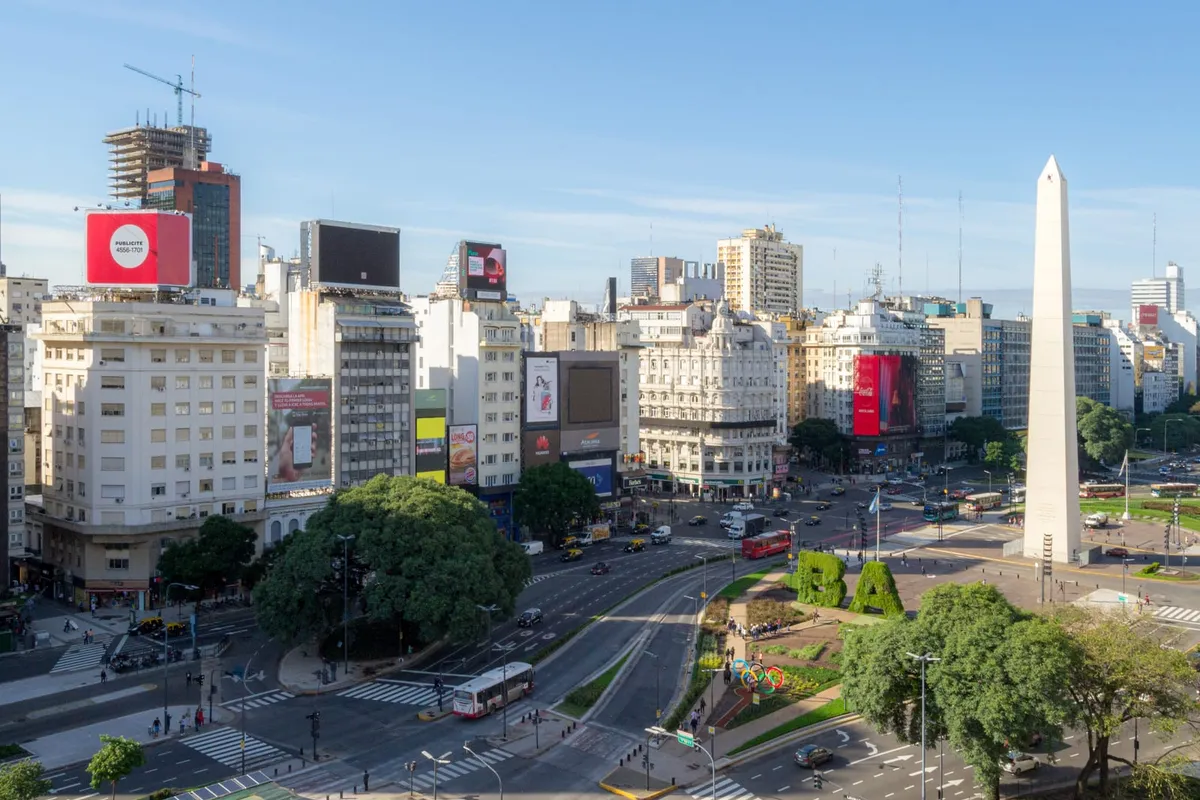
- On foot: from the Obelisk, 15 minutes along Av. Roque Saenz Pena (Diagonal Norte).
- Buses: dozens of lines pass through Plaza de Mayo.