The single most-asked question about Iguazu Falls: Argentine side or Brazilian side? The honest, short answer is that they are not really substitutes — they are two halves of the same wonder. But if your time is limited, here is the verdict, the data, and the reasoning to help you choose.
TL;DR: If you only have time for one side, choose Argentine. It is more immersive, has more trails, and includes the Devil's Throat walkway. The Brazilian side gives you the iconic panoramic view in 2-3 hours and is the perfect complement on day 2. With two full days you get the complete experience; with one day, prioritise Argentina.
The 30-Second Answer
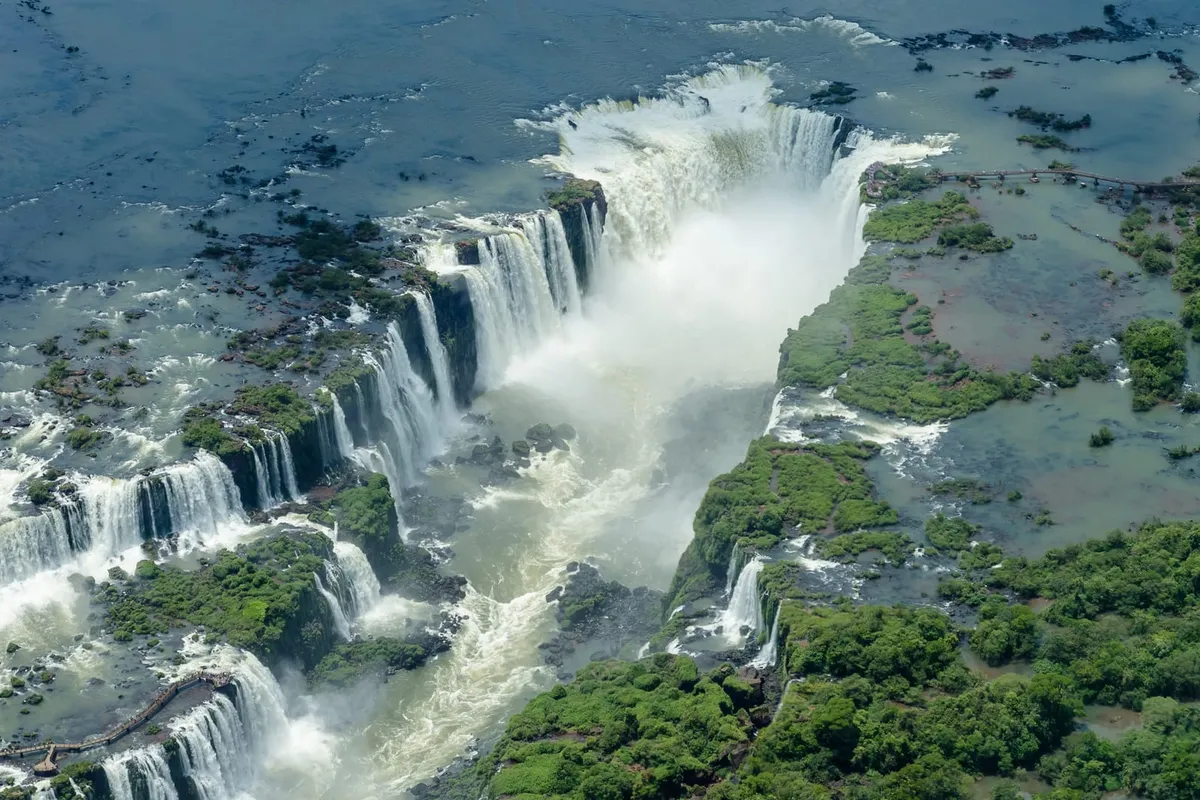
Picture two complementary experiences. Argentine side: you walk literally over and beside the cascades, the spray hits you in the face at the Devil's Throat, you can take a boat under the falls. Brazilian side: you stand back and see all 275 cascades in a single panoramic frame, with the Devil's Throat as a head-on spectacle 80 metres tall. Argentina is depth; Brazil is breadth.
| Dimension | Argentine Side | Brazilian Side |
|---|---|---|
| Time needed | Full day (6-8 hours) | Half day (2-3 hours) |
| Best for | Immersion, adrenaline, hiking | Panoramic photos, families, quick visit |
| Trails (total) | ~8 km across 4 main circuits | 1.2 km (one trail) |
| Entrance (2026) | ARS 25,000 (~USD 25) foreigners | BRL 110 (~USD 22) foreigners |
| Verdict | Choose if you have only one day | Add as a half-day on day 2 |
Argentine Side: Deep Dive
The Iguazu National Park on the Argentine side covers 67,000 hectares and houses about 80% of the falls. The park layout is built for slow exploration — you can spend a full day moving between three main circuits, plus optional jungle trails and a boat ride. An ecological train (free, included) connects the entrance to the Devil's Throat trailhead.
Devil's Throat (Garganta del Diablo) — the centrepiece
A 1,100 m walkway runs across the upper river to the very edge of a U-shaped chasm where 14 falls converge. The roar is so loud you cannot hold a conversation; the spray covers you in seconds; the size of the abyss makes your stomach drop. This is the single most powerful moment on either side of Iguazu and you can only experience it from Argentina. Reach it via the ecological train (15 min) plus the walkway (20 min). Go first thing in the morning or last thing before sunset to avoid crowds.
Upper Circuit (~1.7 km, 1 hour)
An elevated boardwalk that crosses the top of several falls — Bossetti, Adan, Eva, Bernabe Mendez. You see the cascades from above, looking down into the gorge. Easy walking, fully accessible, great morning light. Ends with a panoramic view of San Martin Island.
Lower Circuit (~1.4 km, 1.5-2 hours)
A loop with stairs at the base of the falls, putting you below the cascades. Includes the free shuttle boat to San Martin Island (weather permitting), the launch point for the Great Adventure boat, and one of the best photo spots — a wooden platform soaked in spray with a perpetual rainbow. Some moderate climbing on stairs.
Great Adventure Boat (Gran Aventura) — USD 80
A 12-minute high-speed inflatable boat ride directly under the San Martin and Bossetti falls. The experience starts with a 4 km truck ride through pristine jungle (with wildlife guide), then a brief river safari, then the boat charges twice into the falls. You will be utterly drenched — bring a dry bag, change of clothes, and prepare for unbridled joy. Books up days ahead in high season.
Macuco Trail (~7 km round-trip, 3-4 hours)
A flat jungle hike to a hidden 20-metre waterfall (Salto Arrechea) with a swimming pool at the base. Well-marked, mostly shaded, and the best place in either park to spot wildlife — coatis, agoutis, monkeys, dozens of bird species, hundreds of butterflies. Skip if it has rained heavily (mud can be intense). Bring water, snacks, repellent.
Full Moon Walks
Five nights per month the Argentine park stays open after dark for a guided walk to the Devil's Throat under moonlight. Three time slots from 19:30 to 22:30. The walkway under silver light is otherworldly, and lunar rainbows occasionally appear in the spray. Tickets sell out 4-6 weeks ahead. Full moon dates and booking guide.
Time needed for Argentine side: A rushed day = 6 hours, comfortably full day = 8 hours, with Macuco Trail + boat = 1.5 days.
Brazilian Side: Deep Dive
The Parque Nacional do Iguacu on the Brazilian side has only about 20% of the falls but the trails are designed to maximise the panoramic experience. A mandatory shuttle bus (included in the ticket) connects the entrance to the trailhead. The park is comfortably finished in 2-3 hours, leaving time for the Bird Park or Itaipu in the same day.
Panoramic Walkway (~1.2 km, 1.5-2 hours)
A single cliff-side trail with continuous views across the entire 2.7 km front of falls. The walk descends gently with viewpoints every 100 metres. The final stretch ends at a thrilling platform that juts out into the river right at the base of the Devil's Throat — you stand inside a permanent cloud of spray, with the cascades thundering 80 metres above. A panoramic elevator returns you to the road. Photographers love this side: the wide-angle composition is unbeatable, and the head-on view of the Devil's Throat is unforgettable.
Macuco Safari Boat — BRL 380 (~USD 75)
The Brazilian equivalent of the Great Adventure. A 30-minute ride descends the Iguazu River canyon and charges into the Tres Mosqueteros falls. Includes a jungle truck ride to the launch point. Comparable experience to the Argentine boat — equally drenching, slightly different falls.
Parque das Aves (Bird Park)
Across the road from the Brazilian park entrance, this private bird sanctuary is one of Latin America's largest. You walk inside giant aviaries with toucans, harpy eagles, macaws, flamingos and 1,400+ birds of 150 species — many rescued from illegal trade. There are also pumas, butterflies, and a reptile section. 1.5 hours, BRL 80 (~USD 16). Highly recommended if you have kids or are a bird-watcher.
Helicopter flights
Only available from the Brazilian side. 10-minute panoramic flights for ~USD 300 give you the aerial perspective: the entire 2.7 km front, the Devil's Throat as a single shot, the river canyon snaking into Argentina. The Argentine side bans helicopters for environmental reasons.
Time needed for Brazilian side: Park alone = 2-3 hours. Park + Bird Park = 4 hours. Park + Bird Park + Itaipu = full day.
Side-by-Side Comparison
| Feature | Argentine Side | Brazilian Side |
|---|---|---|
| Walking distance | ~8 km across 3-4 circuits | ~1.2 km (one trail) |
| Time needed | Full day (6-8 hours) | Half day (2-3 hours) |
| Devil's Throat | Walkway over the abyss (look down) | Frontal panoramic view (look across) |
| Best photos | Close-ups, rainbows, walkway shots | Iconic panoramic of the entire front |
| Adrenaline activities | Great Adventure boat (USD 80), Macuco Trail | Macuco Safari boat (USD 75), helicopter (USD 300) |
| Wildlife encounters | Abundant — coatis, monkeys, toucans | Bird Park (separate, paid) |
| Food options | 2 restaurants in the park, kiosks | 1 buffet restaurant + cafes |
| Entrance fee (2026) | ARS ~25,000 (~USD 25) | BRL ~110 (~USD 22) |
| Rest after | Tired but exhilarated | Easy, leaves energy for other activities |
| In-park hotel | Gran Melia Iguazu (USD 400-700) | Belmond Hotel das Cataratas (USD 600-1,200) |
| Closest base city | Puerto Iguazu (15 min by car) | Foz do Iguacu (20 min by car) |
| Crowds peak | 10:00-14:00 at Devil's Throat | 11:00-15:00 at final platform |
| Verdict | More to do, more immersive | The iconic panoramic photo |
Which Side First?
For a 2-day trip, our recommended order is:
- Day 1: Brazilian side (morning) + Bird Park (afternoon). The Brazilian panoramic gives you the wide-angle context. The Bird Park is the perfect mid-afternoon activity. Total walking: light.
- Day 2: Full Argentine side. Now you know the layout and you can dive deep — Devil's Throat first thing, Upper and Lower circuits, optional boat or Macuco Trail. The build-up from panoramic to immersive feels right; you go from "wow, that is huge" to "I am inside it."
The reverse order works too — many tour operators sell the Argentine side first because it is more demanding while you are fresh. Both orders are valid; pick based on your hotel side and weather forecast.
Crossing the Border
The two parks are 25 minutes apart by road, separated by the Iguazu River. The crossing is via the Tancredo Neves International Bridge (489 m). Process:
- Stamp out at the border post you are leaving (Argentine Migraciones or Brazilian Policia Federal).
- Cross the bridge by car, bus or tour van.
- Stamp in at the entry post on the other side.
Total time: 20-30 minutes in normal conditions, 45-60 minutes during peak holidays. Most Western nationalities (US, EU, UK, Canada, Australia, Japan, Mercosur) need no visa for tourism stays up to 90 days — just a passport with 6+ months validity.
On a tour with transport, the guide handles the paperwork on the bus — the easiest option. By taxi, agree the fare upfront (USD 20-30 each way) and use only authorised cross-border taxis. By local bus, you handle immigration on foot — cheap but time-consuming. By rental car, you need advance authorisation from the rental company plus the original vehicle documents.
Detailed step-by-step in our Border Crossing guide.
Combining With Itaipu and the Triple Border
The Brazilian side is well-positioned for two add-ons that share the same day:
- Itaipu Dam — 20 minutes from the Brazilian park. The world's second-largest hydroelectric plant, with standard 2-hour tours from BRL 100 (~USD 20). Pairs well with a morning at the falls and an afternoon at Itaipu.
- Triple Border (Hito Tres Fronteras) — where Argentina, Brazil and Paraguay meet. Three landmarks (one in each country) overlook the confluence of the Iguazu and Parana rivers. Free to visit. Argentine side has the most panoramic platform.
- Ciudad del Este (Paraguay) — 30 minutes from Foz across the Friendship Bridge. Duty-free shopping if that is your thing. Currency: Paraguayan guarani or US dollars. Most travellers skip this unless they want electronics or perfumes.
Where to Base Yourself: Puerto Iguazu vs Foz
Puerto Iguazu (Argentina) — population 90,000, smaller and more relaxed. Walkable centre, great jungle lodges in the Iryapu Reserve (5-10 min from the park gate), restaurants on Avenida Brasil. Mid-range hotels USD 80-150/night. The vibe is "adventure village." Closest to the Argentine park (15 min). For most travellers, Puerto Iguazu is the more atmospheric choice.
Foz do Iguacu (Brazil) — population 260,000, bigger city with more flight connections, more nightlife, more variety of restaurants, and the legendary Belmond Hotel das Cataratas inside the park. Mid-range hotels BRL 400-800/night (~USD 80-160). The vibe is "small Brazilian city with a giant park nearby." Closest to the Brazilian park (20 min) and the airport with most direct flights from Brazilian cities.
For 1-2 nights, pick one — typically Puerto Iguazu if you are coming from Buenos Aires, Foz if you are coming from Brazil. For 3+ nights, split the stay (1-2 nights each). For a luxury splurge, the Belmond and the Gran Melia are the only in-park options.
Detailed picks in our Where to Stay guide and Puerto Iguazu page.
Book Your Tours
 Best seller
 Argentine Side Tour
Full day with transport from Puerto Iguazu. Devil's Throat, Upper & Lower circuits and free time in the park.
Must-see Brazilian Side Tour
Half-day panoramic tour with transport from Puerto Iguazu, border crossing handled by guide.
Top rated Triple Border Landmark Tour
Visit the iconic confluence point where Argentina, Brazil and Paraguay meet on the Parana River.
Best value Hotels in Puerto Iguazu
Find the best deals on jungle lodges and family hotels in Puerto Iguazu, with falls views and free cancellation.
Private Both Sides Full-Day Transfer
Private transfer from Puerto Iguazu covering the Argentine park, border crossing and Brazilian panoramic.
Frequently Asked Questions
Which side of Iguazu Falls is better, Argentina or Brazil?
If you can only do one, choose the Argentine side — it is more immersive, has more trails, and includes the Devil's Throat walkway. The Brazilian side is shorter (2-3 hours) but offers the iconic panoramic view that you cannot see from Argentina. The complete experience is doing both: Brazil first for context, Argentina second for depth.
Can I see both sides of Iguazu in one day?
Technically yes, but it is exhausting and you will miss key experiences. The Argentine side alone needs 4-6 hours, plus the border crossing adds 30-60 minutes each way. With 2 full days, you enjoy both sides without rushing — the recommended approach for almost every traveller.
Do I need a Brazil visa to visit the Brazilian side?
Most Western nationalities (US, EU, UK, Canada, Australia, Japan, Mercosur) do NOT need a visa to enter Brazil for tourism stays up to 90 days. Just bring a passport with 6+ months validity. As of 2026, the previously required eVisa for US/Canada/Australia travellers is suspended. Check your country's rules close to the trip date.
Which side has better hotels?
Both have excellent options. The Brazilian Belmond Hotel das Cataratas is the only colonial-style lodge inside the Brazilian park. The Argentine Gran Melia Iguazu (formerly Sheraton) is the only hotel inside the Argentine park, with falls views from many rooms. Outside the parks, Foz do Iguacu has more variety; Puerto Iguazu has more jungle lodges with pools.
Is the Argentine side worth a second day?
Yes — many travellers say the Argentine side is the highlight of their entire South America trip. With a full day plus a half-day, you can do all three circuits, the Macuco Trail, and the Great Adventure boat without rushing. If you only have one day on the Argentine side, you will hit Devil's Throat and one or two circuits but skip the boat or trail.
Can I drive my rental car across the border?
Yes but it requires paperwork. Most rental contracts require advance written authorisation to cross between Argentina and Brazil, and you must carry the original vehicle documents and rental agreement. Argentine rentals usually charge a USD 50-100 cross-border fee. For a one-day visit to the other side, a tour with transport is far simpler and similar in price.
What is the best month to visit Iguazu Falls?
May, June, August and September strike the best balance — comfortable temperatures (15-22 C), fewer crowds, and good water flow. February-April brings peak flow but also peak heat and Brazilian Carnival crowds. August-September has the lowest water but clearest skies. Avoid mid-July (Brazilian school holiday) and Christmas-New Year for queue and price reasons.
How much does it cost to visit both sides of Iguazu?
Park entrances total roughly USD 47 (Argentina ~USD 25 + Brazil ~USD 22). Add USD 75-80 for one boat ride, USD 160-300 per night for a mid-range hotel, USD 40-80 per day for food, and USD 50-100 for transfers. For a 2-day trip with one boat ride, plan on USD 350-580 per person excluding flights. Budget travellers can do it for USD 200-250.
Are there rip-offs to avoid at Iguazu?
Yes — be aware of: unofficial taxis at the borders charging triple fares (use only authorised taxis or pre-booked transfers); over-priced poncho rentals (bring your own or buy a cheap one in town); aggressive coati feeding (illegal and they bite); and currency exchange at hotels (use ATMs or official cambios for better rates). Also, ignore touts at the bus terminals offering "exclusive" tours — book through reputable operators.
Should I do the boat ride on the Argentine or Brazilian side?
Both boat rides go under the falls and you will get equally drenched. The Argentine "Great Adventure" (USD 80) approaches the San Martin and Bossetti falls; the Brazilian "Macuco Safari" (BRL 380, ~USD 75) descends the canyon below the Devil's Throat. The experiences are very similar — most travellers do whichever side they have more time on. If you want one specific recommendation: the Argentine boat lasts longer and feels more chaotic in a good way.
Related Iguazu Guides
- Iguazu Falls hub — start here for the complete overview
- Best time to visit Iguazu
- Border crossing guide
- How to get to Iguazu
- Iguazu budget guide
- What to pack for Iguazu
- Devil's Throat (Garganta del Diablo)
- Upper Circuit
- Lower Circuit
- Great Adventure boat
- Macuco Trail
- Full Moon walks
- Parque das Aves (Bird Park)
- 2-day itinerary
- 4-day itinerary
This article contains affiliate links. If you book through them, we receive a small commission at no extra cost to you.