Last updated: April 2026
If you only have 48 hours in Buenos Aires, here is how to make them count. The Argentine capital does not give itself up easily — it is huge, the neighborhoods feel like different cities, and locals eat dinner at 22:00. Two days are enough for the postcard version: Plaza de Mayo and the historic center, the cobbled streets and antique fair of San Telmo, the colourful tin houses of La Boca, the marble mausoleums of Recoleta cemetery, the Latin American art of MALBA, and a long parrilla dinner in Palermo with a glass of Malbec. You will skip the Tigre Delta, the estancia day trip and Mataderos — for those, scale up to our 4-day itinerary or the 7-day Argentina route. This guide is built for travelers who land at Ezeiza on Friday night, have Saturday and Sunday in the city, and fly out Monday morning.
Itinerary at a glance
- Duration: 2 full days (48 hours)
- Estimated budget: USD 250-400 per person mid-range, excluding accommodation and flights
- Best months: March-May, September-November
- Suggested base: Recoleta or Palermo Soho
- Transport: Subte (subway) + Cabify/Uber, no rental car
- Walking: 8-12 km per day, comfortable shoes essential
Day 1: Classic Buenos Aires
Morning (09:00-13:00): Plaza de Mayo & the historic center
Start at Plaza de Mayo, the political heart of Argentina since 1810. The pink Casa Rosada is where Eva Peron and Juan Domingo Peron addressed the masses from the famous balcony — free guided tours run on Saturdays and Sundays at 10:00, 12:30 and 14:30 (book online at visitas.casarosada.gob.ar, passport required). Across the plaza, the Catedral Metropolitana (free, open 09:00-19:00) holds the tomb of General Jose de San Martin, the liberator of Argentina, Chile and Peru, guarded by motionless soldiers. The Cabildo on the western side is a small free museum about the May 1810 revolution.
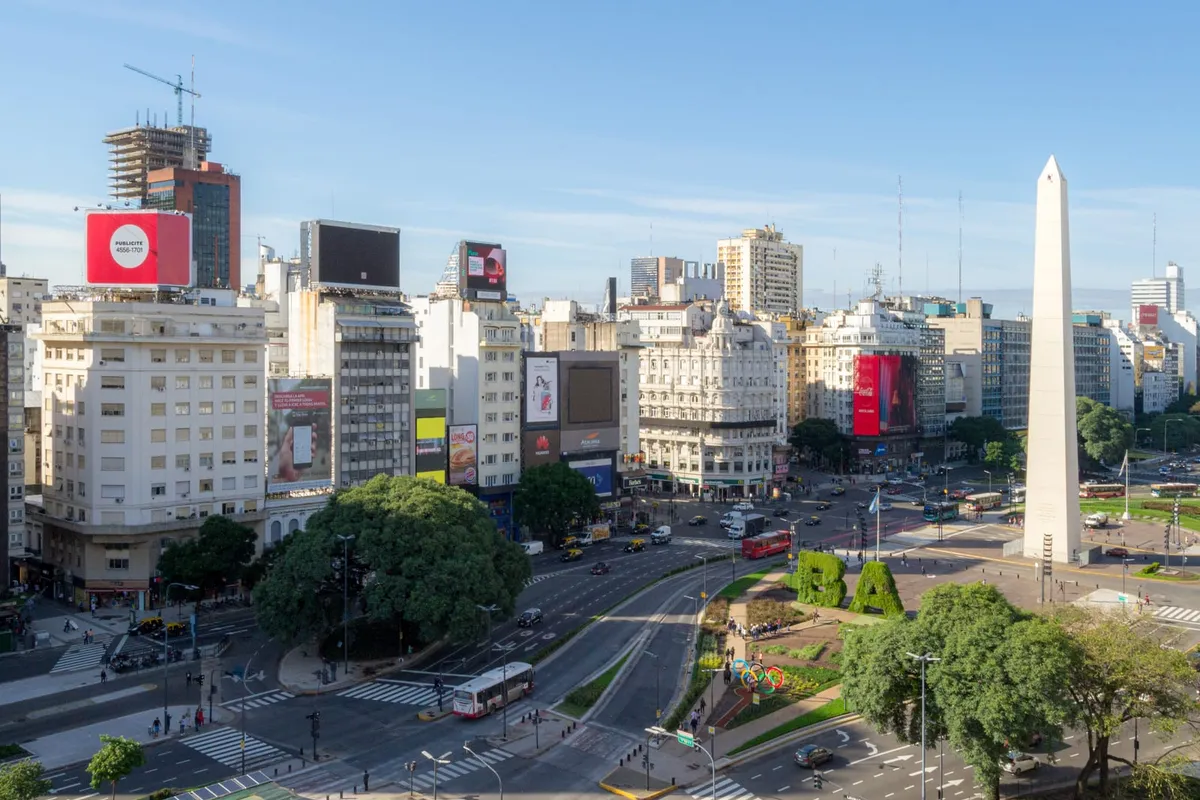
Walk one block north to the Catedral / Plaza de Mayo Subte station and continue along Avenida de Mayo — Buenos Aires at its most Madrid-like, with art nouveau facades, the spectacular Palacio Barolo (tours USD 12, every hour) and the legendary Cafe Tortoni at number 825. Tortoni opened in 1858 and has hosted Borges, Garcia Lorca and Hillary Clinton; expect a 20-minute queue, order a submarino (hot milk with a chocolate bar) plus medialunas (USD 7-10 total). End the morning at the Obelisco on Avenida 9 de Julio, said to be the widest avenue in the world.
Lunch (13:00-14:30): Mercado de San Telmo
Take Subte line E or walk 25 minutes south to San Telmo. The cobbled, tango-soaked neighborhood is the city's bohemian core. Lunch at the historic Mercado de San Telmo (Bolivar 970, open 09:00-21:00): grab empanadas at La Choza (USD 1.50 each), a bondiola sandwich at Hierro (USD 8) or a tasting board with a glass of Malbec at Coco (USD 12-15). On Sundays, the Feria de San Telmo antique market spills along Defensa street with 270 stalls — go early, it gets packed by 13:00.
Afternoon (15:00-18:00): La Boca and Caminito
From San Telmo, take a Cabify (USD 4-5, 10 minutes) — never walk, and never take colectivo bus 152 alone — to La Boca. The neighborhood is the working-class port district that gave Argentina tango, the painter Benito Quinquela Martin and Boca Juniors. Caminito is the open-air pedestrian street with the iconic conventillos (tin tenements painted yellow, blue and red) — touristy but unmissable for 45 minutes of photos and street tango couples (USD 5 tip if they pose with you). Visit Fundacion Proa on the riverbank for contemporary art (USD 4) and the exterior of La Bombonera, the cathedral of Boca Juniors football. Stay strictly inside the tourist perimeter and Cabify out by 17:30.
Evening (20:30+): Tango show and parrilla
Buenos Aires only really wakes up at night. Two valid choices for your one tango evening: a polished tourist show with dinner at Tango Porteno (Cerrito 570, USD 75-110 with dinner, world-class production) or El Querandi (Peru 302, USD 95 with dinner, intimate venue from 1920); or an authentic milonga at La Catedral del Tango (Sarmiento 4006, Palermo, USD 5 cover with class included from 20:00) where real porteños dance until 03:00. If you prefer dinner first, book Don Julio in Palermo (Guatemala 4699, USD 60-90 per person, reserve 30 days ahead — it is on every "world's best parrilla" list) or walk-in to El Desnivel in San Telmo (Defensa 855, full asado plus wine USD 18-25, no reservations, queue 30 min). See our full Buenos Aires tango guide for milonga calendars and dress codes.
Day 2: Modern Buenos Aires
Morning (09:00-12:30): Recoleta Cemetery and MALBA
Take a Cabify or Subte to Recoleta Cemetery (Junin 1760, free entry, open 08:00-18:00). Founded in 1822, this is a city of 4,691 marble mausoleums where Argentina buries its presidents, generals and oligarchs. The most-visited grave is Eva Peron's tomb in the Duarte family vault on the third aisle from the entrance — modest compared to the surrounding pomp, which is the point. Allow 75 minutes; download the free Recoleta Cemetery app for a self-guided audio tour. Coffee at La Biela across the street (USD 5-7 for a cortado and three medialunas) under the centenary rubber tree.
Walk 15 minutes south through the elegant Plaza Francia gardens to MALBA (Avenida Figueroa Alcorta 3415, USD 8, open 12:00-20:00, closed Tuesdays). MALBA holds the most important Latin American art collection in the city: Frida Kahlo's "Self-Portrait with Monkey and Parrot," Diego Rivera, Tarsila do Amaral, Antonio Berni's giant Juanito Laguna collages. Allow 90 minutes plus the well-curated gift shop.
Lunch (13:00-14:30): Palermo Soho
Walk or Cabify (USD 3) to Palermo Soho. Lunch options: Cumana (Rodriguez Pena 1149, traditional locro and empanadas, USD 12-18 per person) for Argentine comfort food; Sarkis (Thames 1101, Armenian, USD 15-20, family-style) for something different; or i Latina (Murillo 725, multi-course Latin American tasting, USD 70 per person) if you want to splurge.
Afternoon (15:00-18:30): Bosques de Palermo and Palermo Soho
Walk off lunch in the Bosques de Palermo, the 250-hectare park system with the Rosedal (rose garden, 18,000 roses, free), the artificial lakes where porteños rent paddle boats (USD 4 / 30 min), the elegant Jardin Japones (USD 3, koi ponds and a small tea house) and the Planetario Galileo Galilei. Then drift south through Palermo Soho — the boutique-shopping core around Plaza Serrano (officially Plazoleta Cortazar). Come for independent Argentine fashion (Rapsodia, Jazmin Chebar, Mishka), leather goods (28 Sport, Casa Lopez) and concept stores. Saturdays and Sundays the plaza fills with a craft market.
Evening (20:30+): Parrilla dinner in Palermo Hollywood
Walk 15 minutes north under the railway tracks to Palermo Hollywood, the gastronomy capital of Buenos Aires. Top three options for a final-night parrilla: Don Julio (book ahead, USD 60-90 per person, 9.5 / 10 on every list); La Cabrera (Cabrera 5099, USD 50-70, famous for free side dishes); Proper (Aranguren 1059, USD 40-60, modern wood-fire cooking, easier to reserve). Pair with a Catena Zapata Malbec or a Bonarda from Mendoza (USD 25-45 a bottle). For after-dinner drinks, the speakeasy Frank's Bar (Arevalo 1443, password required from their Instagram) is the classic pick. See our Buenos Aires food guide for more steakhouse and bar recommendations.
Where to stay for 2 days
For a 48-hour trip, location beats luxury — you do not want to lose 30 minutes in Cabify each direction. Two clear winners.
- Recoleta: elegant, walkable, the safest neighborhood for first-time visitors. You sleep two blocks from the cemetery and 15 minutes on foot from MALBA. Best for over-35 travelers and couples. Hotel picks: Alvear Palace Hotel (5-star classic, USD 350+), Hotel Lyon (4-star apart-hotel, USD 110-150), Hub Porteno (boutique, USD 200-280).
- Palermo Soho: the best restaurants and nightlife at your doorstep. Best for under-40 travelers and foodies. Picks: Home Hotel (boutique, USD 180-240), Casa Calma (4-star wellness, USD 150-200), Vain Boutique Hotel (3-star design, USD 90-130). Avoid hostels on Niceto Vega — loud until 06:00.
Skip Microcentro hotels (dead at night, no restaurants nearby) and Puerto Madero unless you are travelling on business — it looks great but feels sterile after dinner. See our complete Buenos Aires where-to-stay guide for neighborhood-by-neighborhood comparisons.
Practical tips
- Subte (subway): single ride USD 0.50 with a SUBE card. Buy a SUBE card at any kiosk (USD 2 deposit) and load credit. Lines A, B, C, D, E and H cover most tourist points; trains run 05:00-23:00 weekdays, 06:00-22:00 Sundays. Avoid rush hour 18:00-19:30.
- Cabify and Uber: both work perfectly. A Cabify across town costs USD 4-8. Pay with foreign credit card. Always preferable to street taxis at night.
- Cash and money: bring USD bills (USD 100s preferred, clean and uncreased) and exchange them at "cuevas" — informal exchange offices on Calle Florida — at the "blue dollar" rate, which is 30-50% better than the official bank rate. For smaller amounts, Western Union also gives a near-blue rate. Most restaurants accept cards, but tip 10% in cash. ATMs charge USD 8-12 per withdrawal and limit you to USD 100, so they are the worst option.
- Tipping: 10% in restaurants (in cash, even when paying card), 5-10% taxis, USD 1-2 to hotel porters, USD 3-5 per person to free walking tour guides.
- Neighborhoods to avoid at night: Constitucion, Once, La Boca outside Caminito, Retiro bus terminal area, Avenida 9 de Julio south of Plaza de Mayo. Stick to Recoleta, Palermo, Puerto Madero, Las Canitas — all very safe after dark.
- Tap water: safe to drink across the city. Restaurants sometimes charge for "agua de mesa" (USD 2-3) — ask for "agua de la canilla" (tap) if you want to skip the upsell.
- SIM cards: Claro, Movistar and Personal sell tourist SIMs at Ezeiza airport (USD 8-12 for 10 GB / 7 days). Or use eSIM via Airalo before flying.
- Time zone and meal times: dinner starts at 21:00 minimum, 22:00 is normal. Most restaurants do not open before 20:00. Lunch is 13:00-15:30. Many shops close 13:00-16:30 outside Palermo.
What you'll miss (and why you should consider 4 or 7 days)
Two days is a "best-of" but it forces real cuts. The biggest omissions:
- Tigre Delta: a half-day boat trip through the Parana river islands, 50 minutes by Mitre train from Retiro. The escape from the city most travelers love. See Tigre guide.
- Estancia day trip: a working ranch outside the city — gauchos, asado, horseback riding. The classic option is Santa Susana (Civitatis tour, USD 95 with transport, lunch and show, full day). See estancias guide.
- Football match: Boca Juniors at La Bombonera or River Plate at El Monumental are bucket-list experiences but require a tour operator (USD 90-160) and a free matchday — see our Buenos Aires football guide.
- Mataderos Fair: the gaucho fair every Sunday with folkloric music and traditional games — completely off the tourist circuit. See Mataderos guide.
- Colonia del Sacramento: a UNESCO-listed colonial town in Uruguay, 1 hour by Buquebus ferry. Easy day trip with passport. See Colonia guide.
- San Antonio de Areco: the gaucho heartland 110 km west, with silversmiths and pampas estancias. See San Antonio de Areco guide.
- Teatro Colon backstage tour: one of the world's three best opera houses (50 min tour, USD 25, daily at 11:00 and 15:00 in English). See Teatro Colon page.
If any two of those sound essential, scale up to 4 days in Buenos Aires — it adds Tigre, an estancia option, deeper Palermo time and a football matchday slot. Or jump to the broader 7-day Argentina itinerary that pairs Buenos Aires with Iguazu Falls. For neighborhood deep-dives, see our all Buenos Aires itineraries hub and the regional Buenos Aires guide.